

Skip to Navigation Skip to Content

No Room at the Top: Why No Women on Web 2.0 Boards?

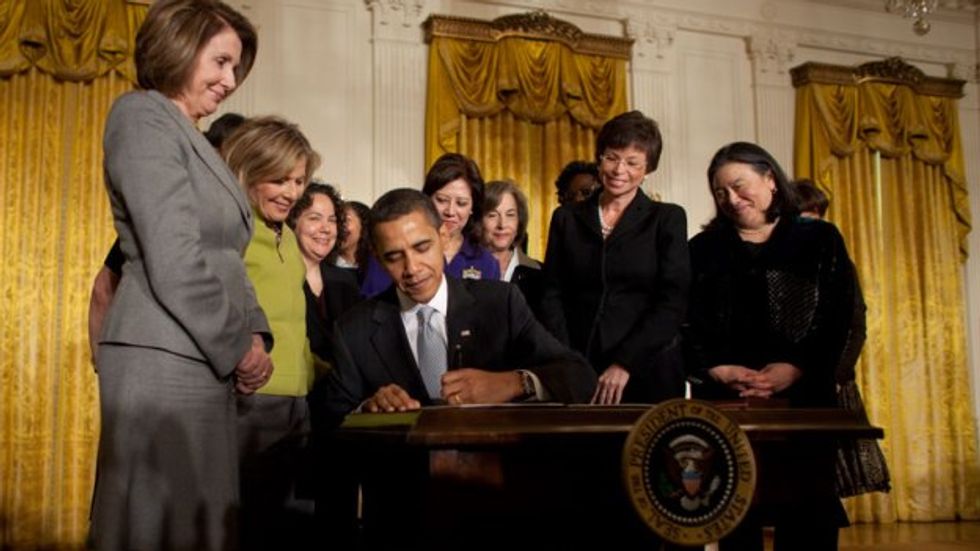
President Obama signs executive order creating White House Council on Women and Girls. Photo by Chuck Kennedy (White House Public Domain)

In every neighborhood where tech startups are located, you’ll see them – small groups of bright young men, mainly engineers, going out to lunch together. Very occasionally, there will be a woman who is part of the group, but that’s an exception that proves the rule.

It’s an odd phenomenon, this gender segregation, especially because virtually none of these young men fit the old-fashioned stereotype of sexists; by contrast, their generation supports equality between men and women more  than any in the past.

And as these companies grow, they hire plenty of women. At Twitter, for example, a recent estimate has women accounting for around a quarter of the workforce.

But where the paucity of women is most striking is on the boards of directors of Web 2.0 companies. In a piece last December for the Wall Street Journal, Kara Swisher documented that none of the leading companies in this sector – Twitter (9 members), Facebook (5), Zynga (5), Groupon (9) and Foursquare (3)-- had a single woman on their board!

(I can find no evidence that this has changed since then, but some of these companies do make their current board makeup hard to locate.)

In any event, we can now add another company to the zero women list, and this one has an ironic twist. Last week, while researching my post on Pandora Radio, I read the company's explanation of its name:

The name Pandora means "all gifted" in Greek. In ancient Greek mythology, Pandora received many gifts from the Gods, including the gift of music, from Apollo. She was also, as we all know, insatiably curious...

Of course, among all the Greek Gods, Pandora was also the first woman.  And, as Robin Wolaner, author of Naked in the Boardroom: A CEO Bares Her Secrets So You Can Transform Your Career, first pointed out to me, all 14 members of Pandora's soon-to-be-public board of directors are men.

If someone was keeping score for these six companies, all of which (except Groupon) are headquartered or have a major office in the super-progressive Bay Area, it would be Boys 45, Girls 0.

Swisher’s piece on this issue sparked a lot of discussion; last time I checked there were 61 comments on the article’s page. Rbrtchng wrote: “I think this ‘issue’ is silly. Maybe no women are on these boards because they did not find women with the right credentials…It’s about ability, not sexism. I mean, go to any Computer Science class or any engineering class in any universities, women are pretty sparse compared to men in this field.”

Over time, this imbalance looks to be changing. Between 1978-1998, the percentage of women engineers in the U.S. increased from two to nine percent of the total. Over the past decade, various reports indicate that roughly 20 percent of university engineering students now are women.

In addition, there are plenty of women executives who have risen to positions of prominence throughout the tech sector generally and in some of the companies named in this story specifically.

So why is there a dearth of them on the board level of top 2.0 companies? I'm fresh out of theories myself; so if you've got one please comment below...


 

Women might not be on boards of these companies, but the glass ceiling has broken in other arenas. Perhaps one way that women can get noticed and asked onto boards is by making themselves social media mavens. Quickly. Their value and experience in this arena will undoubtedly prove valuable to boards.

Our organization, The Green Chamber of Commerce, (greenchamberofcommerce.net) is the anti-good-old-boy network. We have a very diverse board, over 70% women. Perhaps creating new entities and ways of doing business is the kind of direction we might want to take in building a more fair and just economy.

One major reason there are few women on the boards of tech companies is that they don't get promoted the same way men do in the first 10-15 years of their careers, so they move on to different careers. This isn't conjecture; this is a fact. You can check this out in the research report called "The Facts" by the National Center for Women in Information Technology (NCWIT): http://ncwit.org/thefacts

Thanks, Francine. Yes engineers are most definitely only part of the story. There are some serious governance issues around boards that extend well beyond the tech community, of course. And critical thinkers (which tend to also be outspoken) seldom to be valued as board members, even though they would probably help companies avoid some of the serious errors they make. A bunch of yes-men is of little use in this regard.

I am one of the most vocal advocates for women on corporate boards. And this has nOTHING to do with women engineers. It has to do with running sustainable businesses.The board member does not have to be an engineer. That's what the people inside the company do.

For myself, I know I have never been ased to be on a corporate board (although I am on many advisory boards) because I am too outspoken.

Thank you all for the comments. Since I asked for others to theorize, I should  add my own idea, somewhat reluctantly. I've been working in media in one capacity or another since I was a teenager many decades ago. Back then, it was a field completely dominated by men. There really weren't any Lois Lanes, as far as I could tell. But my generation brokes down the walls, just as we did in so many other ways. Still, it continued to be easier for men to advance than women. Some of the reasons are well-known, having to do with biology, child-rearing, and life choicies. But others are more subtle, involving which people are able to act like leaders or appear to be more confident than they may actually be inside. I noticed early on that in key meetings, men tended to make declarative statements while women often raised questions, inviting conversation, but appearing (in men's eyes) less confident in the process. But if we fast-forward from then to now, social media (Web 2.0) represents clearly a much more "feminine" type of channel, involving community, sharing and connection -- all of which women have traditionally been better at than men. This new media form has emerged mainly due to a technological push; thus the predominant position of male engineers to date. For these companies to mature and endure, however, IMHO, they need to diversfy their leadership on many levels, the first of which would be to add women to their boards. There are countless female candidates out there. The companies that follow this lead will gain a competitive advantage. In the end, that is one reson why I wrote this article. To promote that as a best practice for new businesses.

I'll be speaking on the panel that Kara is moderating at this conference. I wrote an article for Wired News over ten years ago about all girls school in SIlicon Valley that was started to address this very issue. http://www.wired.com/culture/lifestyle/news/1997/10/7987 I wonder how it's doing? I'm no biological determinist, but women's brains are certainly wired for Web 2.0, so not sure what's happening. Lots to explore.

I'd like someone to do a thoughtful article on how few women get to the top in all kinds of industries. I thought we'd fought this battle 30 years ago when I was in college, and yet here I am, a veteran journalist, wondering why so many of the bylines in major national magazines are those of men. You asked for a theory. I think it's all about mentoring. It's just hard for senior men to take junior women under their wings and groom them.

Quoting commentators in a story is pointless as most have no authority to speak on the subject. Better to research facts instead. Look at how many executives and board members at these above-quoted companies have computer science degrees. You'll find that degrees in computer science are not as essential as being tapped by certain influential networking groups.
Women can study as hard as they want for as long as they want but they won't be invited to lunch or to the boardroom as long as the GoB's hold the purse.

Here's a theory: men don't want to give up their power. Simple as that.

For what it's worth, female enrollment in computer science is actually lower now than it was 20 years ago. This isn't true across all fields of engineering, but it's the one that matters for this line of work.

btw, Kara Swisher will be there speaking.

If you are interested in this topic there is an excellent conference tomorrow for women here in SF at the City Club. The Exceptional Women in Publishing Women’s Leadership Conference. Check out detail here-- http://www.ewip.org/conference/ 7X7, you should be there.