

The sun is just beginning to rise as we pick our way across a boulder-strewn beach in Northern Sonoma. Harbor seals, languid on the rocks, watch our progress with hooded eyes.
The tide is already beginning to come back in, so we have to work fast.
When I signed up for an uni foraging class with Berkeley-based educational collective Fork in the Path, I imagined a careful, methodical hunt through the tidepools for a handful of elusive purple pin cushions. Now that I’m here, I can see just how wrong I was.
Though native to the California coast, sea urchins have been causing serious problems for the ecosystem ever since their primary predator, the sunflower sea star, began dying off in large numbers. A decade-plus of unchecked reproduction later, the uni are everywhere, clustered together by the dozens to form a muppet-like skin over the rocks.
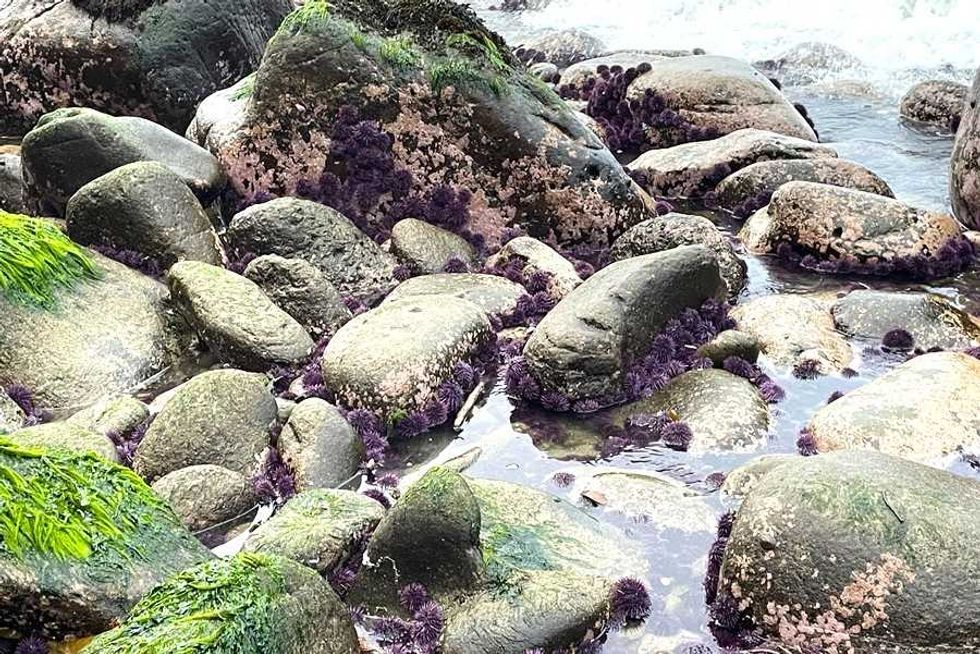 Purple sea urchins form a puppet skin on the rocks.(Shoshi Parks)
Foraging instructor Ryn Sullivan gives us a quick lesson in detaching the urchins. These are living animals, they remind us. You loosen them gently, sliding a spoon or a knife between their underbellies and the rocks to which they are suctioned. When they pop off, their soft spines wriggle in silent protest.
Place the urchin in a bucket then move on to the next; a one-day fishing license gives every forager the right to take home up to 35 of them. The number, which sounded enormous at first, I now realize will hardly make a dent in the population on this single beach, let alone the hundreds of others up and down the West Coast.
The concentration in this area is what’s called an “urchin barren,” co-instructor Ricardo Romero Gianoli explains later, while we feast on the fresh, briny uni. Once upon a time, not that long ago, kelp forests grew in these waters, lush ecosystems in which seaweed and invertebrates like abalone, sea stars, crabs, and urchin lived in harmonious balance.
Then came “the Blob,” not a monstrous sea creature but a massive, ocean-warming heat wave that lingered in Pacific waters so long, it suffocated the giant bull kelp and killed off the nutrients on which it depended for life.
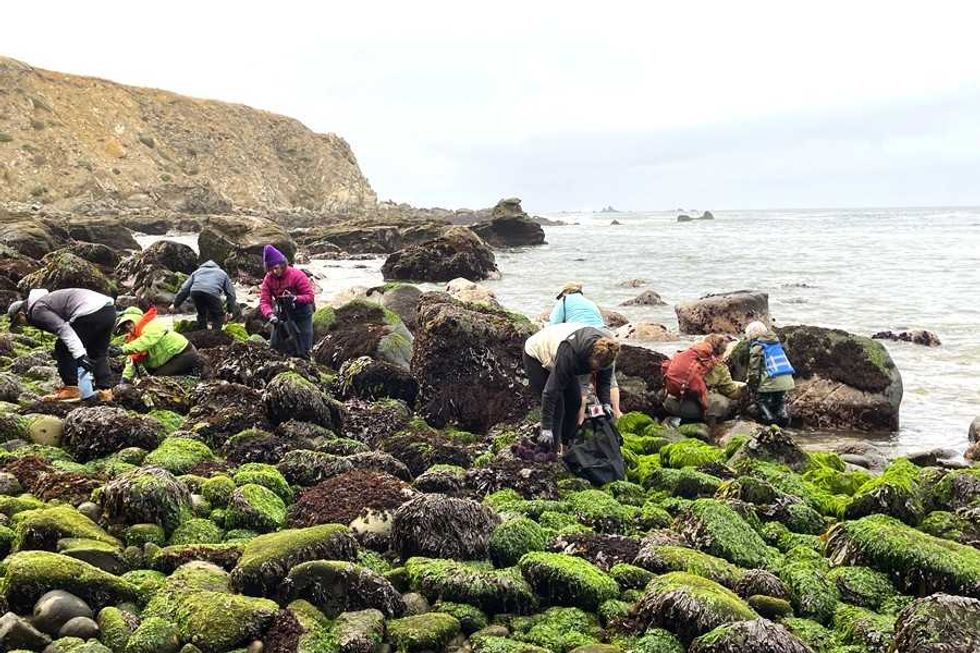 Foraging for purple sea urchin in Northern Sonoma(Shoshi Parks)
By the time the Blob reached our coast in 2014, the intertidal ecosystem was already in trouble. A deadly bacteria, Vibrio pectenicida, the cause of Sea Star Wasting Disease, had already been melting the urchin’s top regional predator into literal jelly. But the warm water sent the disease into hyperdrive, absolutely decimating sunflower sea star populations that once numbered in the billions. Last year, only about a dozen were recorded having been seen in Northern Sonoma, says Gianoli.
With nothing left to hunt them, purple sea urchin numbers exploded. Ravenous kelp and algae grazers with immense appetites, they systematically mowed down entire underwater forests. As of now, they’ve destroyed an estimated 90 to 95 percent of those found on the California coast. This is bad—not just because it means the devastation of native species, but because kelp forests are essential to the sequestration of carbon in the atmosphere, combating ocean acidification, and preventing the erosion of vulnerable shorelines. Without them, the planet as a whole is far more poorly equipped to face the disastrously warming climate.
The purple sea urchin, meanwhile, are hearty little buggers. Even after they’ve consumed all of the water’s nutrients, they can exist in a zombie-like state of torpor for up to 40 years, according to Gianoli. New kelp can’t even begin to grow because, like a real-life scene from a horror movie, the starving sea urchins take it down the moment they realize there’s anything there to eat.
It’s essential, then, that each forager collects the full number of their allotted 35 urchins, whether they’re going to eat them all or not. Harvesting the little guys who are just beginning to produce offspring is, in fact, just as—if not more—important than collecting the larger individuals with fully developed reproductive organs. They won’t have much that’s edible inside—fun fact: the part of the purple sea urchin we eat is actually its gonads—but it’ll prevent them from adding to the problem.
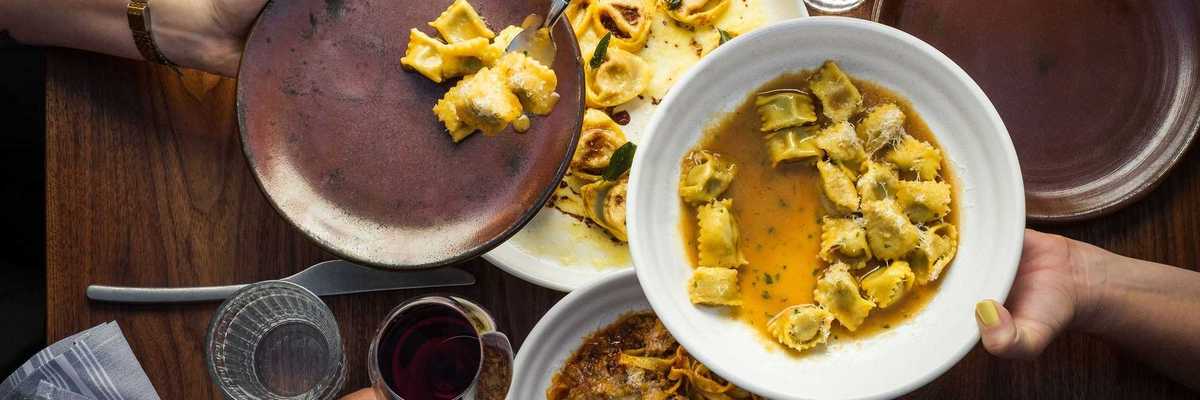
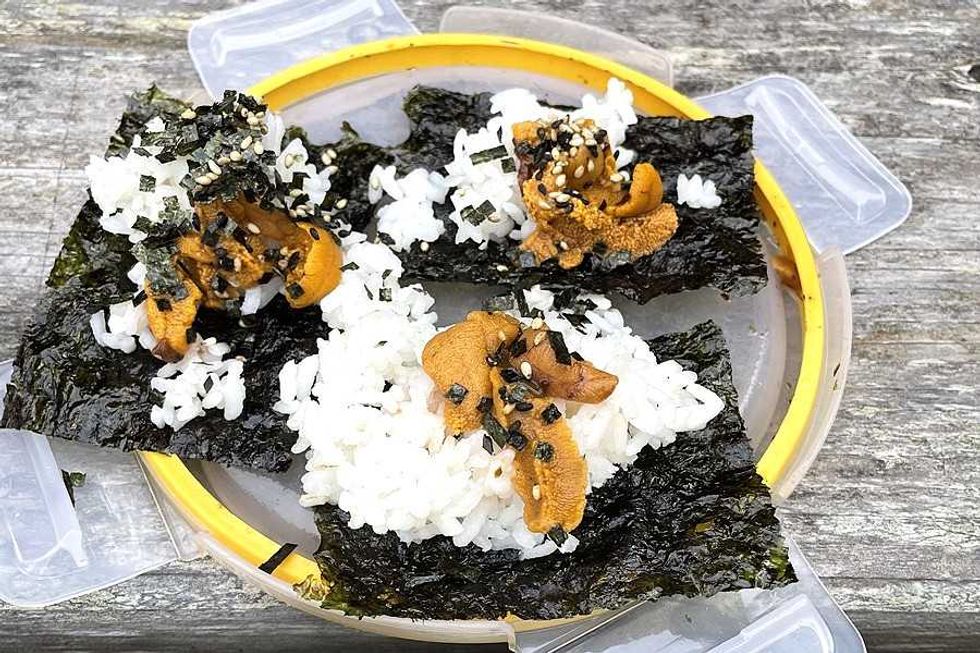 Handrolls made with freshly foraged uni(Shoshi Parks)
On the beach, Sullivan demonstrates exactly how to extract the uni from our buckets full of them by placing two spoons back-to-back on either side of the “Aristotle’s lantern” (the urchin’s five-sided jaw) and push the handles up to split the animal in half. Inside is a gooey black mass of digesting algae and, holding fast to the body’s interior, its uni. Scoop that bit out, put it in a colander resting in a bowl of sea water, and the good stuff easily separates from the bad.
We kill, clean, and remove only what we plan to eat at our communal uni feast back up on top of the bluff. The instructors provide a few basics for making simple handrolls (steamed rice, dried seaweed, and soy sauce) and some of the foragers have brought with them elaborate accoutrements from wedges of citrus to spices to homemade sauces.
Any of the urchins you don’t plan to eat right away need to be kept intact and alive, explains Sullivan. The organ is so delicate that it spoils quickly after removal. Within around 24 hours, even the uni still safe inside the animal will become inedible. Any that you don’t get to in time make a nice addition to a compost pile.
The class runs a little over three hours and, while getting out to the coast by 5am was something of a challenge, it feels incredible to have done something to help chip away at this very real environmental catastrophe before most people have even made breakfast. They can have their eggs and toast—those of us here, we’ve already eaten.
// Fork In The Path offers regular uni classes along with a wide variety of other seasonal foraging (including mushrooms, seaweed, mussels, and acorns), cooking, and nature-based classes around Northern California. See their calendar and sign up at forkinthepath.org.
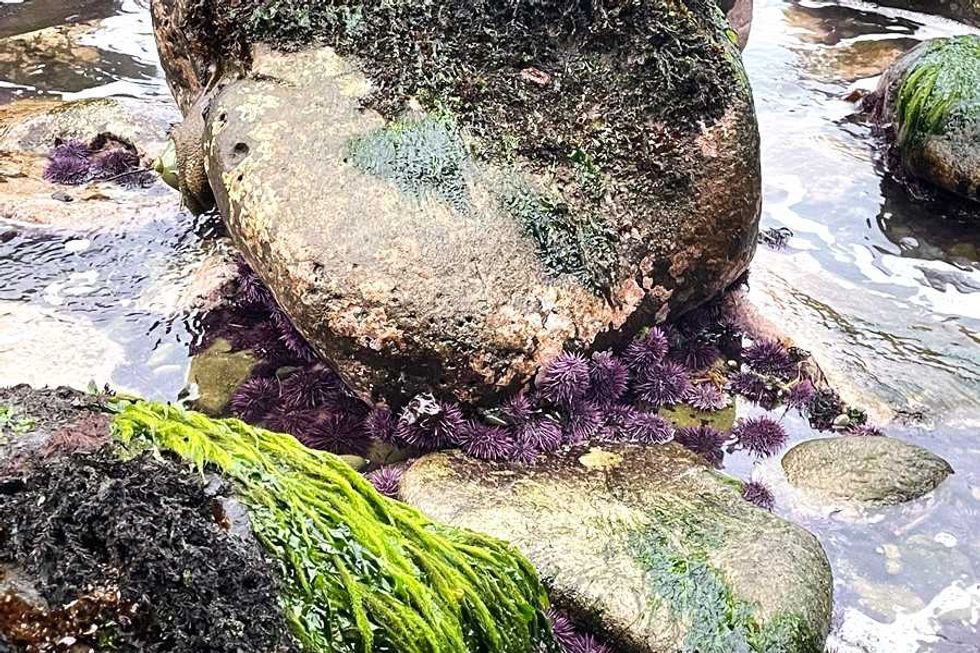 The Northern California coast is now an "urchin barren" devoid of up to 95 percent of the kelp forests that were present just ten years ago.(Shoshi Parks)