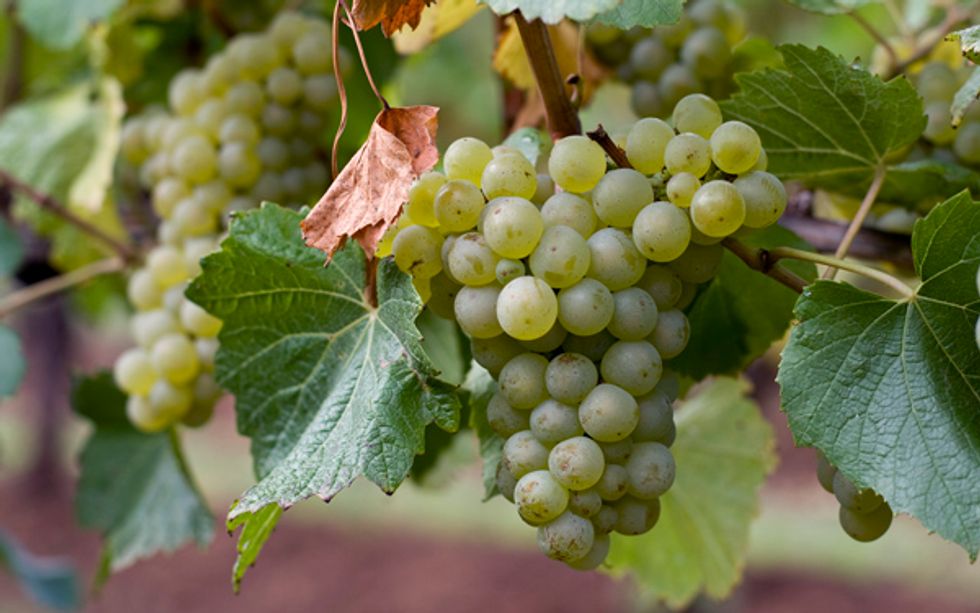

On Monday in Livermore, a celebration was held in the honor of a noble lady. Hailing from Burgundy, she is now the most popular of her kind in the United States.* Her name is Chardonnay. In 1936, she first appeared on the label of a wine (before that she was categorized merely as “miscellaneous”) and now, just 75 years later, wine professionals joke that they will have and serve “ABC”: Anything But Chardonnay.
What happened? Was it her meteoric rise to stardom? The fact that she was suddenly everywhere — on boxed wine and bottles of “two-buck Chuck?” Did we tire of her the way we tire of seeing Kim Kardashian? Whatever it is, Chardonnay is slowly and steadily working her way back to her rightful place on the throne in California, thanks to the dedicated work of a handful of winemakers.
“Chardonnay is queen of the grapes,” says Stéphane Vivier, the winemaker at Hyde de Villaine in Carneros. Vivier hints at one reason for the great Chardonnay backlash of recent years: In the U.S. we simply allowed her to put on a little weight. Yep, Burgundy’s queen got a little flabby out here in California. In Burgundy, says Vivier, Chardonnay “stands straight and strong in the glass.” In keeping with that tradition, he makes wines that “have height and not flesh.”
The winemakers who gathered at Wente Vineyards, where some of the very first Chardonnay in California was planted, have completely different approaches to crafting the noble queen: Karl Wente believes that the “fruit should stay on a pedestal,” while Greg La Follette actively goes about making non-fruity wines, embracing Chardonnay’s more visceral, animal tendencies. Some of them stir the lees every week for months, some not at all. Some age in new oak, some in stainless steel. Some use wild yeast, some innoculate with very specific strands.
But there were a few things even these very different winemakers could agree upon when it comes to making elegant, stately Chardonnay: The importance of place and the preservation of natural acidity.
“Site trumps just about everything else,” says La Follette, who is notorious for his molecular approach to making wine. Not surprisingly, Burgundy native Vivier walks his vineyards every day and says that you need to do this for at least 12 years to understand your site: “Terroir needs to be found and respected,” he says.
The backbone of Chardonnay, or her corset perhaps, that keeps her standing so tall, is her natural acidity. Protecting that acidity, both in the vineyard and in the winery is every winemaker’s great challenge. Michael MacNeill, of Hanzell Vineyards in Sonoma, says “you can’t make Chardonnay without acidity.” The Henzell 2009, even though half of the wine had gone through malolactic fermentation, was fresh and even refreshing — just the way a good Chardonnay (and any wine for that matter) should be.
Do you find yourself snubbing Chardonnay? Get over it, and try these wines right now:
2009 HDV Chardonnay: Boasting a range of fruit flavors from pear to pineapple, this wine from the dry-farmed Hyde Vineyard is made from the “Old Wente” clone, notorious for producing “hens and chicks” or a mix of small and large berries.
2009 LaFollette Chardonnay, Sangiacomo Vineyard: Described as a “picture perfect year,” this wine, fermented with wild yeast and aged sur lie for 10 months, has a rich, creamy mouthfeel and a long, minerally finish.
2011 Wente Vineyards, Eric’s Small Lot Chardonnay: Using Chablis as his inspiration, this wine showcases Livermore fruit in its most “naked and exposed” form. Fermented and aged in stainless steel, with no malolactic fermentation, it is all minerality and citrus with a distinct crisp green apple finish.
*Chardonnay was the number one selling varietal wine in 2010 in the U.S. There are now 95,271 acres planted in California (twenty percent more than in Burgundy).