

Rohan Krishnamurthy uses the phrase “bridge building” a lot. He thinks that’s what The Lunchbox—the wildly popular musical at Berkeley Repertory Theatre—and the Alaya Project, a group he’s in that blends classical Carnatic music with jazz and funk, do.
Really, music in general is a great way to reach people, says Krishnamurthy, who, while devoted to Indian music, has learned all he can about other types as well.
“I realized how rhythm is a universal language that truly could connect so many different genres and people and styles,” he says. “I was really turned on to this idea, and that's when I also started learning about some of the other collaborations that have happened in the past, starting, of course, with the Beatles and [Ravi] Shankar.”
Krishnamurthy also likes the word “blessings,” and feels he’s had a lot of them in his life. And it’s true—for a kid growing up in the small town of Kalamazoo, Michigan to become a successful and sought-after Indian percussionist seems like it required some luck along with prestigious talent.
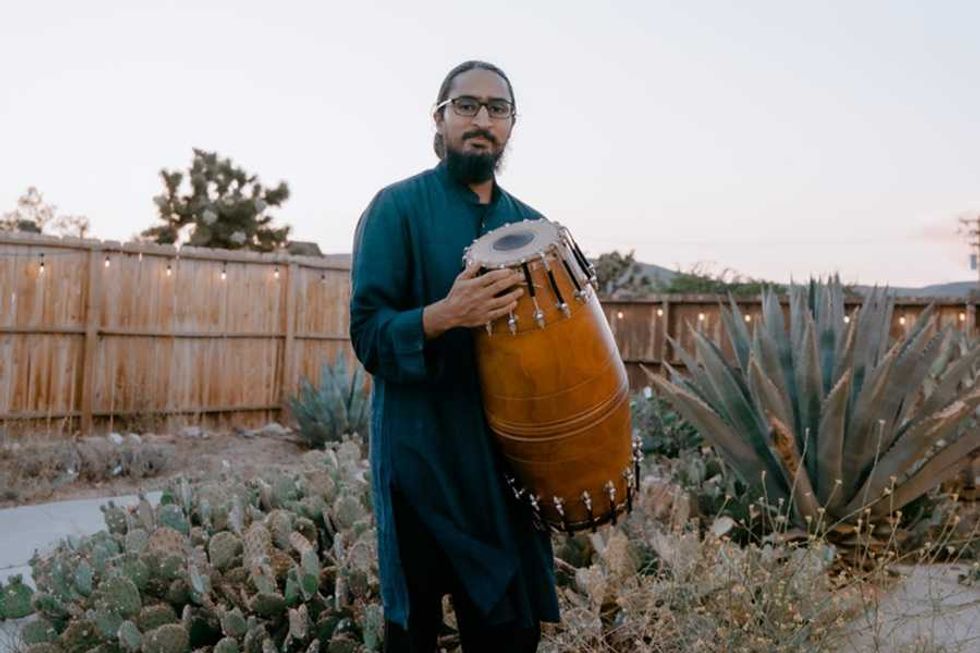 Krishnamurthy with his mridangam (Riley Kathleen)
He was lucky that his Western Michigan University geography and environmental professor father and his accountant mother loved Indian classical music and had a huge collection of records and tapes. He was lucky they had a mridangam in the house, a double-headed hand drum (which you can see Krishnamurthy playing onstage in The Lunchbox). He was lucky that a grad student at the college played the instrument and was willing to become Krishnamurthy’s teacher when he was just eight years old. In a truly startling development in a pre- Skype, pre-Zoom era, they continued the lessons by phone when the student graduated and moved to Massachusetts.
Serendipity intervened again when Krishnamurthy was nine. The mridangam legend Guruvayur Dorai came to play at Michigan State University in Lansing. His uncle, who taught there, took Krishnamurthy backstage before the concert to meet Dorai. They talked, and Dorai invited Krishnamurthy to sit on stage while he played.
But it wasn’t just luck that, after the concert, Dorai made the offer to Krishnamurthy’s parents to teach their son when they came to visit Chennai, India in the summer. That probably wouldn’t have happened without Krishnamurthy showing his devotion to the art form by sitting entranced on the stage for five hours.
Krishnamurthy considers being part of The Lunchbox, which has been extended twice at Berkeley Rep and is now closing on July 12th, one of the greatest blessings of all. He's proud to be part of such a successful and unique project, a musical adaptation of the 2013 film about a misdelivered lunch in Mumbai that ends up creating a bond between two lonely people. Krishnamurthy, who lives in Oakland with his wife and two young children, says more than 50 of his friends and family members have been to see the show (on the day we talked, his parents were coming out from Michigan to go to a performance).
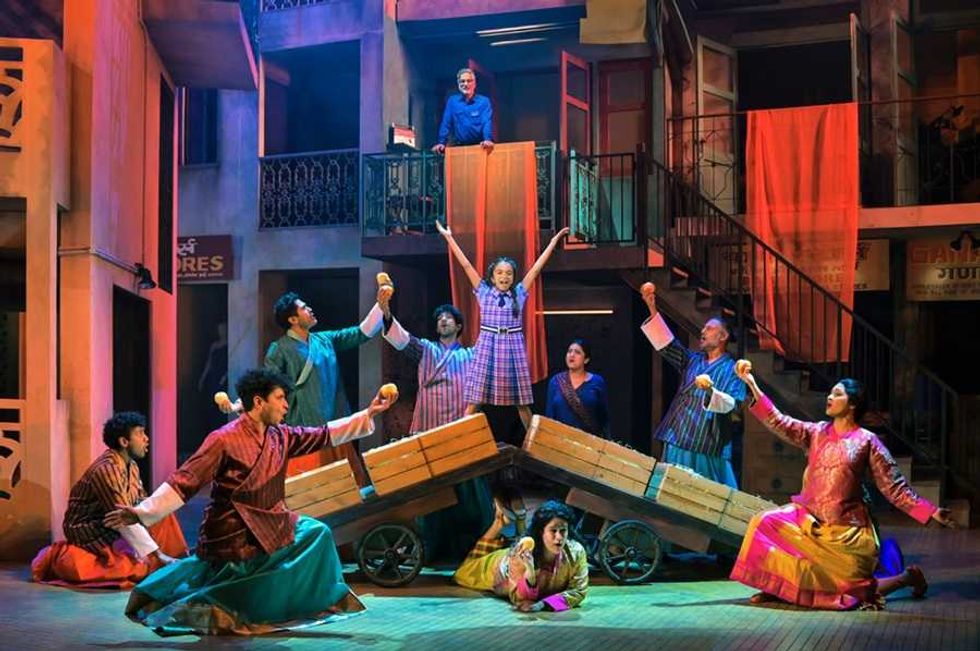 A scene from 'The Lunchbox' on now through July 12th at Berkeley Rep(Courtesy of Berkeley Rep)
“Literally everyone has just resoundingly been overwhelmed by the production and loved every aspect of it,” he says. “So much of what we do tends to be very niche and you kind of keep reaching the same niche audience, but I've noticed in the month-plus that we've been doing the show that many people are coming to Berkeley Rep for the first time, and many people actually have not seen the movie either. I think it's amazing to think that people are coming in for the first time, almost totally as a blank slate.”
Growing up, Krishnamurthy says he never made a conscious decision to be a professional musician—but he became one anyway, playing in places like Chicago and Detroit when he was still a child, as well as performing in a music festival in Chennai.
“People started seeing that I was playing, and I was pretty serious, so they started calling me for shows, and by like 10 or 11, I was kind of on tour,” Krishnamurthy remembers. “I was playing in the Midwest every month, and my parents would drive me all over the place on the weekend, and I'd be taking my homework with me.”
After majoring in music and chemistry at Kalamazoo College (his senior thesis was Acoustics of the Mridangam: Study of a New Design of a South Indian Drum, and he went on to patent a new, more user-friendly drumhead tuning system), Krishnamurthy received a Ph.D. in musicology from the Eastman School of Music in New York. He wrote his dissertation on teaching music online, and while there, studied many different musical traditions, including jazz, pop, and Indonesian gamelan—another blessing, he thinks.
That love of musical intersections led to the Alaya Project. Since high school, he’s been performing with the sax player in the group, Prasant Radhakrishnan, whom he calls an inspiration. The group had been brewing a long time, but the official launch came in 2017. Krishnamurthy, who moved out to the Bay Area in 2013 after earning his doctorate, was asked to be part of a tribute concert for a 50th anniversary celebration of the Beatles’ 1967 album Sgt. Pepper’s Lonely Hearts Club Band at Berkeley’s UC Theatre.
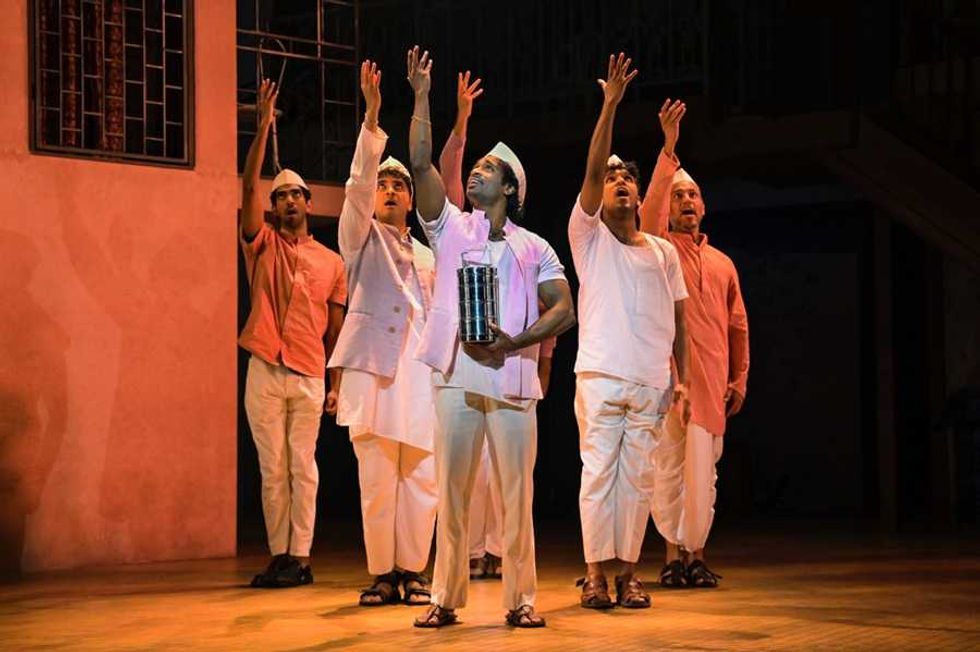 A scene from 'The Lunchbox' on now through July 12th at Berkeley Rep(Courtesy of Berkeley Rep)
Krishnamurthy expected to be asked to do “Within You, Without You,” which features Indian music and George Harrison on the sitar, but instead they asked him to perform “Being for the Benefit of Mr. Kite!” Krishnamurthy called Radhakrishnan and Colin Hogan, who plays piano in the trio, and the three agreed it would be a way for them to combine the different styles of music in the way they had talked about.
“The following year, in early 2018, we started forming a set list of songs, and we rehearsed and developed things, and then we started playing a lot all over the Bay—the jazz festival circuit and global music venues,” says Krishnamurthy.
“That's kind of how it started, but it's funny because we often end our shows with ‘Being for the Benefit of Mr. Kite!,’ kind of coming full circle.”
// ‘The Lunchbox’ is on stage at Berkeley Rep through July 12th; Roda Theatre, 2025 Addison St. (Berkeley), get tickets at berkeleyrep.org