

The Eames Institute in Richmond, California, dedicated to “preserving and promoting” the legacy of modernist design heroes Ray and Charles Eames, recently expanded. It has new exhibitions available to tour, as well as spaces for events like panel discussions and film screenings.
Llisa Demetrios, chief curator of the institute and the granddaughter of Charles and his first wife, says all kinds of people sign up to walk through the collection—some superfans and some who have barely heard of the signature Eames chairs. Education, she says, starts right away with an image on the wall.
 The new Welcome Center at the Eames Institute(Courtesy of the Eames Institute)
“There are some people who come on the tour and think that Ray and Charles are brothers,” Demetrios says. “This is our first lesson—they were a married couple.”
Ray Eames started out her artistic life as a painter, while Charles began as an architect. Demetrios points to the skirt Ray wears in the image.
“Ray designed her own clothing, which can be architectural too, and in that skirt, there are 10 pockets. You can’t see them—they’re deep pockets that have her sketch pad, her sewing kit, her camera—it's her toolkit without you even realizing it,” she says.
The collection, which Demetrios’ mother inherited after Ray’s passing in 1988, contains 40,000 items. It took seven people five years to count everything. Many of the objects aren’t on view in Richmond (the institute is working on a full museum that’s set to open at the midcentury Novato warehouse that was home to Birkenstock USA in 2030), but you get some idea of the collection’s immensity walking through boxes of toys (Demetrios says there are more than 200) with labels like “Dolls Japan” and “Clay figures.” In another room are shelves and shelves of books on subjects including architecture, art, Hollywood, and geography.
These set the tone for the way the Eames explored materials and ideas, Demetrios says.
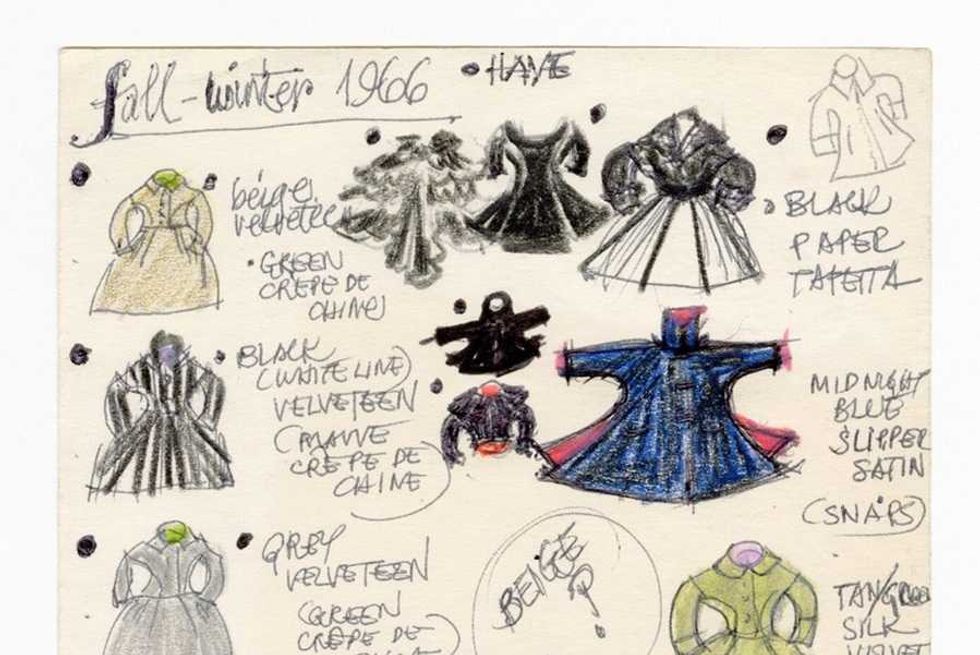 Ray's packing list(Courtesy of the Eames Institute)
“It starts maybe with furniture, but they're going to end up doing exhibits. They're going to do graphics. They're going to do aquarium proposals, multi-screen presentations,” she explains. “For me it begins with their own home that they designed, and also the collections [like] their toy collection and their library, and how those become the grounding of things that will come.”
In a digital age, people long for physical items, Demetrios says, and they love seeing tools used by the Eameses. Some of the items on view are letters, family photos, packing lists on which Ray drew things like the dresses and shoes and gloves she would take, and her early paintings.
Other eye-catching items include a musical tower. Demetrios demonstrates how to ring a bell to signal someone on the floor above to drop a marble down the 15-foot vertical xylophone, which plays a tune by Elmer Bernstein, known for his work on film scores, including some of short ones by the Eameses.
There’s also a “Magic Square,” part of the Mathematica: A World of Numbers. . . and Beyond exhibition they produced in 1961 for a new wing at the California Museum of Science and Industry in Los Angeles. They researched the most popular exhibit at science museums before designing it, says Demetrious—a chick hatching out of an egg. The Eameses knew whatever they created had to beat that (although it would be difficult to be cuter). From the 12-or-so concepts they came up with, their favorite was the magic square, in which columns and rows add up to the same number. Three-by-three versions have been around since medieval times, says Demetrious; the one they made is eight-by-eight.
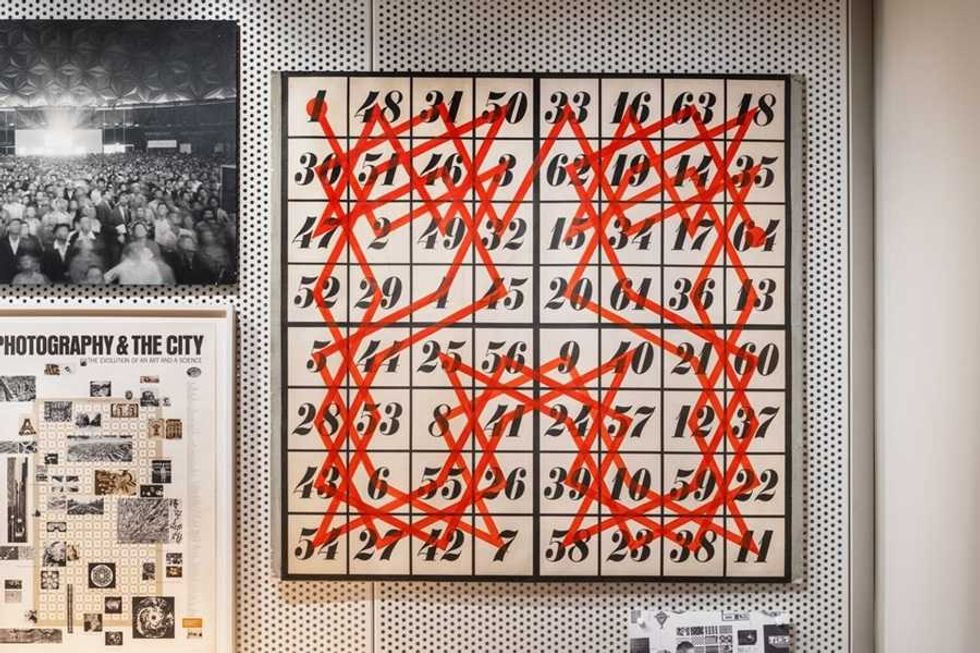 The Magic Square(Courtesy of the Eames Institute)
Walking through the institute, you also see stacks and stacks of the chairs that made the couple famous in an array of colors and styles. Demetrios grew up surrounded by bold hues. As a child, she thought rainbows came from these drawers, she says, opening one filled with a collection of yellow, red, orange, and green pencils.
Demetrios hopes visitors get more than just the joy of encountering these physical objects from touring the collection; she hopes they get a sense of how design can solve problems and make the world better. She loves the motto the Eameses had when they worked with furniture maker Herman Miller, that there’s “goodness all the way down.”
“It has to be good for the company, good for the person making the furniture, good for the designer, good for the community, and good for the environment,” Demetrios explains.
The upcoming museum will be able to take these ideas even further, she adds.
“It's going to be far more than just Ray and Charles' work and designs. It's also going to be world-class artists, as well as up-and-coming artists. It's going to be about making and materials. It's going to be about design and architecture and art.”
// Eames Archives Guided tours start at 10am on Wednesdays, Thursdays, and Fridays, and must be booked in advance. Tickets are released for each month at 10am on the first day of the previous month; 1330 S. 51st St. (Richmond), eamesinstitute.org
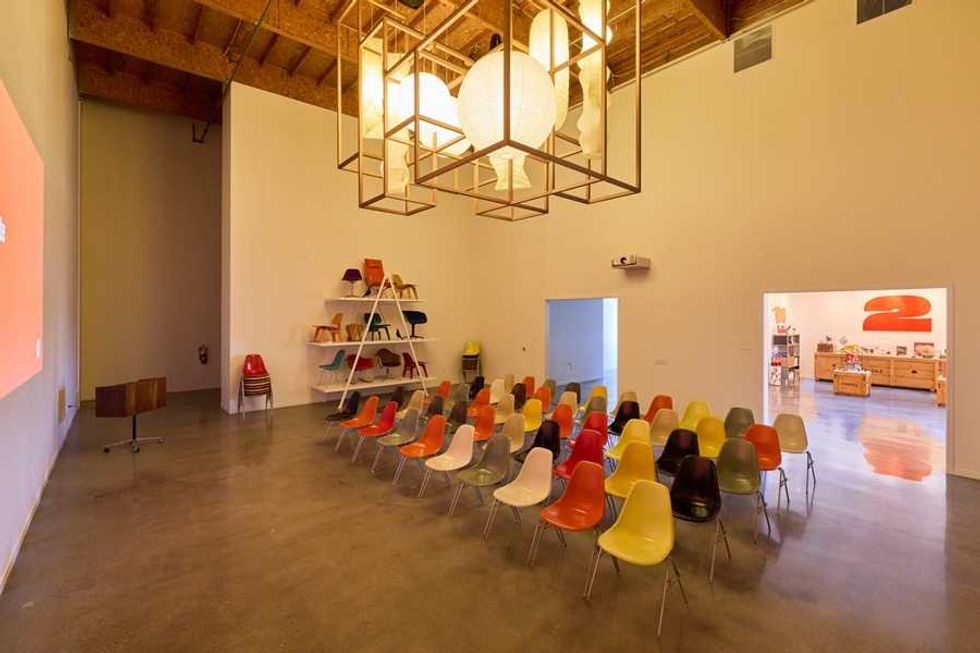 The new Connections Center at the Eames InstituteCourtesy of the Eames Institute)