
Skip to Navigation Skip to Content

Want to Read Your Magazines on an iPad? Maybe Wait a While…

Things move so fast in the world of technology that we can sometimes lose sight of just how new some of it still is. And sometimes that very newness can cause problems.

As I was sitting in a Cole Valley café recently, watching Craig Newmark of Craigslist demonstrate how he uses his iPad (on a tiny easel) to handle customer support issues, it struck me that only a year ago this scene never could have happened.

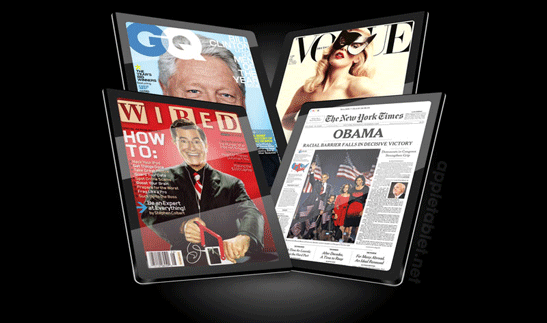
After all, Cupertino-based Apple only introduced the iPad, probably the most super-hyped tech product of all time, in late January 2009. They sold like hotcakes, and media companies, especially magazines, raced to create iPad apps on the assumption that they represented the future reading platform of choice.

But that future may not be here quite yet. The latest figures indicate that magazine apps are not proving to be very popular with consumers over time.

San Francisco-based Wired magazine, for example, launched its iPad app to great fanfare last June, and reported 100,000 downloads in its first month.

According to the Audit Bureau of Circulations, that figure had plummeted more than 75 percent to only 23,000 for Wired’s November issue, and other magazines that reported figures suffered similar declines.

So what’s the problem?

Paris-based media consultant Frédéric Filloux noted several reasons earlier this week. One is the same thing that doomed early magazine websites – shovelware. When a magazine that has been designed for a glossy format is ported over to the much smaller tablet platform, it loses much of its aesthetic appeal.

Another issue is the cost. Most magazines charge the same amount for a monthly download as they do for an old-fashioned copy at the newsstand.

Additionally, the iPad versions of magazines are not searchable, and therefore no more useful to keep around than those old stacks of paper issues you keep meaning to go through some day in the future.

All of these issues will no doubt be fixed in time. But the iPad’s hefty price tag – around $550 once you add in a case – remains a bit pricey for most magazine readers.

Prices will inevitably come down, thanks to competition. Toshiba announced its own tablet this week, which will run on Google’s Android operating system, and other devices are on the way.

It’s a good guess that one or more of the cellphone carriers will be offering tablets for around $100 before the year is out.

So, given that magazine publishers are still figuring out how to adapt their products to the tablet, and with prices for the devices sure to fall, the smart magazine consumer may wish to just wait this one out.


David Weir is a veteran journalist who has worked at Rolling Stone, California, Mother Jones, Business 2.0, the Stanford Social Innovation Review, KQED, Salon, Wired Digital and was the founding editor of 7x7. He co-founded the Center for Investigative Reporting and is on the editorial board of The Nation magazine.


I agree with the comments that magazines have not yet adapted to mobile platforms like the iPad in a number of essential ways. First, as I noted in the post, they have not designed a user experienced that is optimal for the iPad. This will require careful interface design, including new ways to navigate through their content, plus a badly needed search function.

Magazines also have not figured out the subscription model. Not many people are going to pay $200 a year for a magazine that costs far less in print form, just for the convenience of an app.

If I had to guess, and it is just that -- a guess -- I'd expect much better designs to appear in 2011, because it is no secret in the industry that you can't just shovel content onto an iPad and expect it to sing. But I bet it will be 2012 before a new business model emerges that combines the cost of the app, a subscription fee, plus advertising into some semlblence of the revenue streams print magazines rely on.

Somewhere in all of this, a new role for aggregators will emerge as well, but I'll leave that for another post.

The media business has yet to understand let alone embrace the digital world. They will die eventually but during the course of their demise the quality of what you buy will get worse and worse. That's what you are paying for, often at a price greater than the paper edition.

Other issues, photo quality is not as good as in print. On a iPad screen, frequently illegible due to the small screen and the idiotic margins the mags are using. On Zinio you can zoom in, which means you read part of a page at a time, the fonts get fuzzy and the entire experience is lousy.

This overlooks what seems to be the biggest problem: subscriptions. Popular print magazines sell most of their circulation through subscription. Newsstand sales account for a tiny fraction of readers. The Apple Store doesn't offer subscriptions yet. And they don't allow magazines to offer their iPad editions free to their print subscribers. What does this mean? The New Yorker is my favorite magazine, and it's great on the iPad. I subscribe to the print edition for about $40 a year. Here are my options: 1) Keep getting the print edition every week, and pay $4.99 extra whenever there's an issue I want to read on the iPad instead. 2) Cancel my print subscription, and buy an iPad issue every week, which will cost more than $200 a year. The iPad edition makes no sense for anyone except a very occasional reader who has no interest in subscribing. So, until the subscription problem gets fixed, the iPad is an opportunity for publishers, at great cost, to put out a version of their magazine for a small number of their least loyal customers.

The problem with Wired's app is that despite all the fanfare and arrogant self-congratulation it inspired, it basically sucks. It's colorful, yes, and includes some gimmicky interactivity, but it still looks and feels very much like a product that was created by people who are heavily invested in the conventions of print magazine design. That's another way of saying it feels like a pdf on hallucinogenics, which represents a fundamental failure of Wired's own McLuhan test. Wired's failure is not particularly unique in the magazine world, but it is particularly glaring.

Meanwhile, I love love loves me some Flipboard, but that's a very different creature than a professionally edited magazine (which I believe will still have a place in the universe). The irony is that, yes, the flipboard experience is also VASTLY BETTER than most professionally edited and produced magazines.

I guess this explains why 7X7 doesn't have one yet. They're just not ready!

Uh...Flipboard.

Reading this in Flipbook right now!

The future isn't an iPad magazine reader app like Zinio.

The future is Flipboard (and other similar apps to follow). First of all, it's *your* stuff. You get to choose what content feeds Flipboard. Second, the interaction with Flipboard is highly unusual. There is no other news-reading app on the iPad like it.