
On a clear afternoon along the waterfront, R-Evolution rises in front of the Ferry Building with quiet confidence. Facing the city, it stands as a marker of resilience and renewal, a reminder that San Francisco’s identity extends beyond technology to the creativity expressed through art.
That sensibility defines the Big Art Loop, a project built on a simple and surprisingly radical idea: art does not need walls. With nearly 100 sculptures unfolding across the city, the loop forms a 34-mile walkable and bikeable path through San Francisco. Encountered as part of daily life—on foot, by bike, or entirely by chance—it feels less like an event and more like a shared experience.
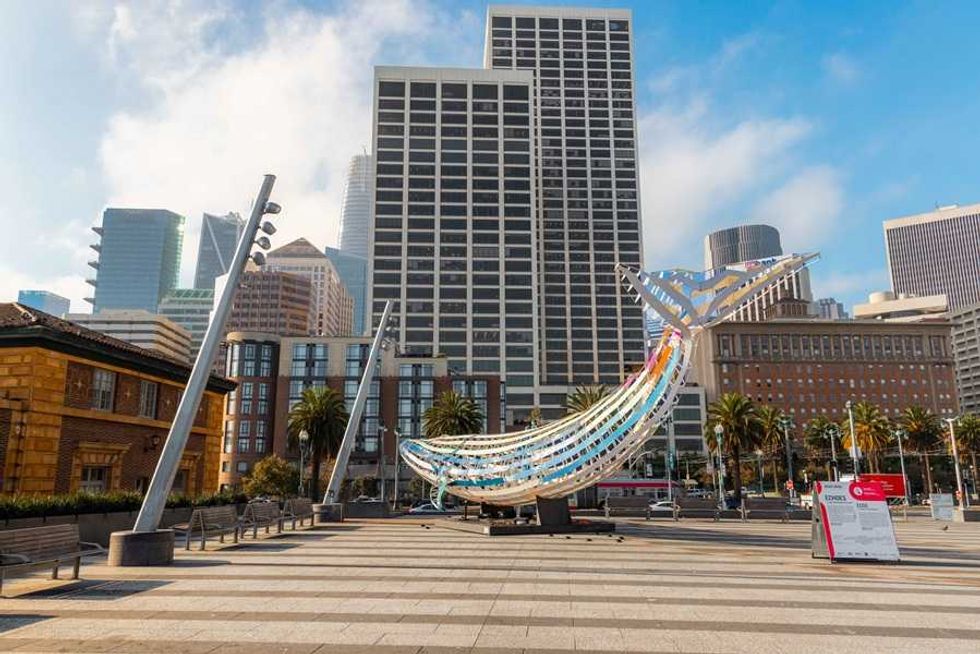 'Echoes: A Voice from Uncharted Waters'(Masaki Omor)
The vision behind the Big Art Loop comes from Sid Sijbrandij, co-founder and executive chair of GitLab, and Karen Sijbrandij, founders of The Sijbrandij Foundation. After making San Francisco their home, the couple set out to bring ambitious contemporary sculpture out of museums and into everyday life.
“This is a gift to San Francisco from the Sijbrandij family,” says Big Art Loop CEO Aliza Marks. “It’s about using art to help revitalize the city and bring people back into public space.”
With support from Mayor Daniel Lurie, the project has closely collaborated with municipal agencies to, as he put it, “bring creativity into our neighborhoods, connect people through activated public spaces, and drive our economy.”
There is no best way—or fixed starting point—to experience the loop. You encounter it as you move through the city, often without planning to. Still, the area around the Ferry Building feels like an ideal beginning, where R-Evolution, a Burning Man legacy, now stands.
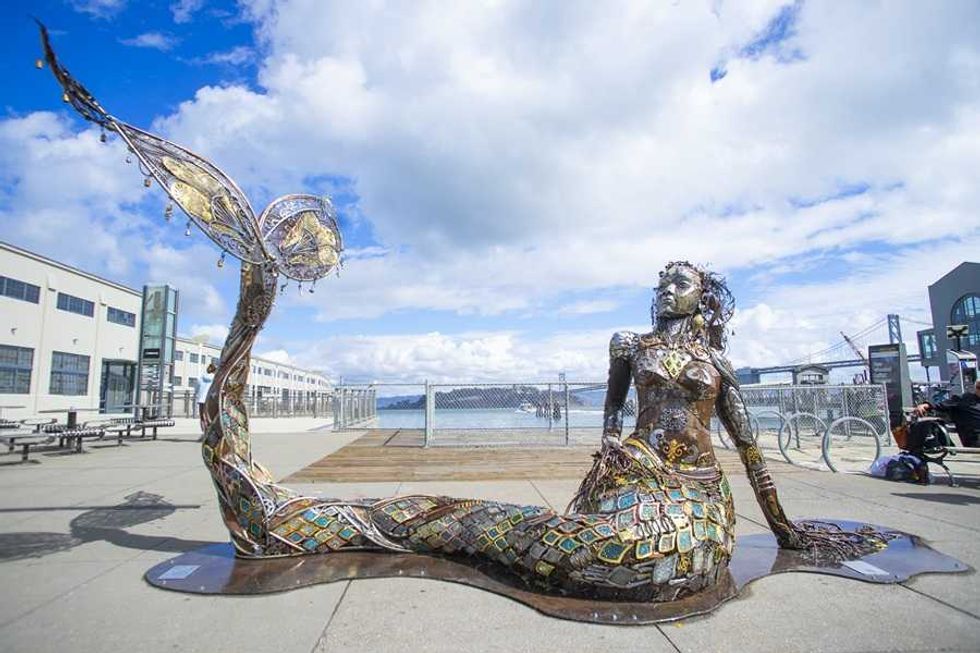 ''Coralée'(BJB)
Just steps away at WETA Plaza, Echoes: A Voice from Uncharted Waters has become the quiet focus of the square. People on break sit in the plaza, coffee in hand, while commuters line up for the next ferry. For a moment, everyone grows quiet, drawn to the whale sculpture and sharing a reflective pause.
Moving north toward Pier 1/2, the tone softens further. Coralée sits closer to the water, inviting a more intimate encounter. Often compared to Copenhagen’s Little Mermaid, whereas the Danish statue gazes outward to sea, Coralée faces the city and the people who pass by. Ferries drift behind her while the skyline unfolds ahead, creating a moment of stillness between departures and arrivals.
Nearby, Got Framed brings a lighter, celebratory energy. Skaters pass beneath the 12-foot-tall golden frame, while newly married couples stop to take photos, drawn by the scenic backdrop of the Bay. Designed to be experienced up close, the piece blurs the line between viewer and artwork. You are no longer simply looking at the art; you are part of it.
Continuing along the waterfront near Fisherman’s Wharf, Desert Shark brings a sharper edge. Also emerging from Nevada’s Black Rock Desert, its angular form introduces tension in a familiar setting, often sparking strong emotions, especially among Burners. Marks recalls a moment when a man stopped suddenly in front of the piece. “He was completely overcome,” she says. “You could see him reliving his experience in the desert.”
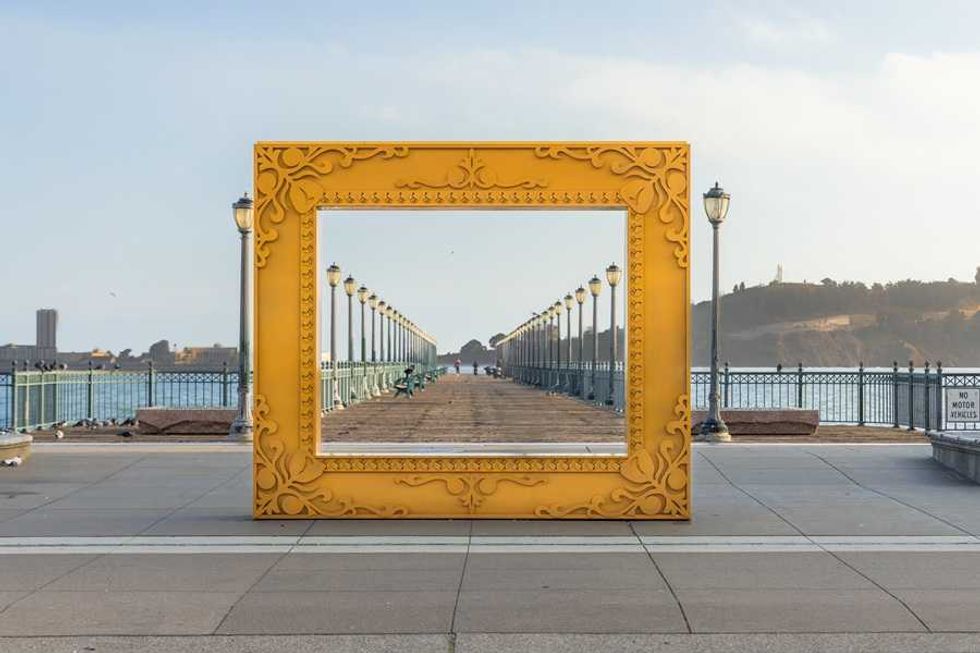 'Got Framed'(Masaki Omor)
As the loop moves inland, the experience turns more inward. Traces: In Order to Remember and Le Retour des Soleils form a double feature by Betsabeé Romero, bringing together international journeys and shared symbolism. Traces was previously shown on Park Avenue in New York, where its imprinted forms spoke to movement, memory, and migration, while Le Retour des Soleils, exhibited near the Louvre Museum in Paris, draws on sun imagery to evoke cycles of renewal and continuity. Now installed along JFK Drive near Golden Gate Park, the pairing quietly brings echoes of both cities into San Francisco’s everyday landscape.
There is more to discover in the park. Beyond the reflective pause of Romero’s work, Naga introduces a mythological presence, while nearby, Octavius invites physical engagement. Designed to be climbed and explored, it draws children instinctively and captures one of Big Art Loop’s most meaningful objectives: making art intuitive, accessible, and shared across generations.
The journey reaches its quietest conclusion in the Sunset District, where The Giraffes appear almost unexpectedly against the open sky: a life-size bronze pair that feel like a final sighting on an urban art safari.
The ambition behind Big Art Loop is deliberately long-term. This is not a temporary installation, but a framework designed to grow alongside the city. Within the next three years, dozens more sculptures will arrive to join those already on display. The city is a gallery now, and you are a part of it.
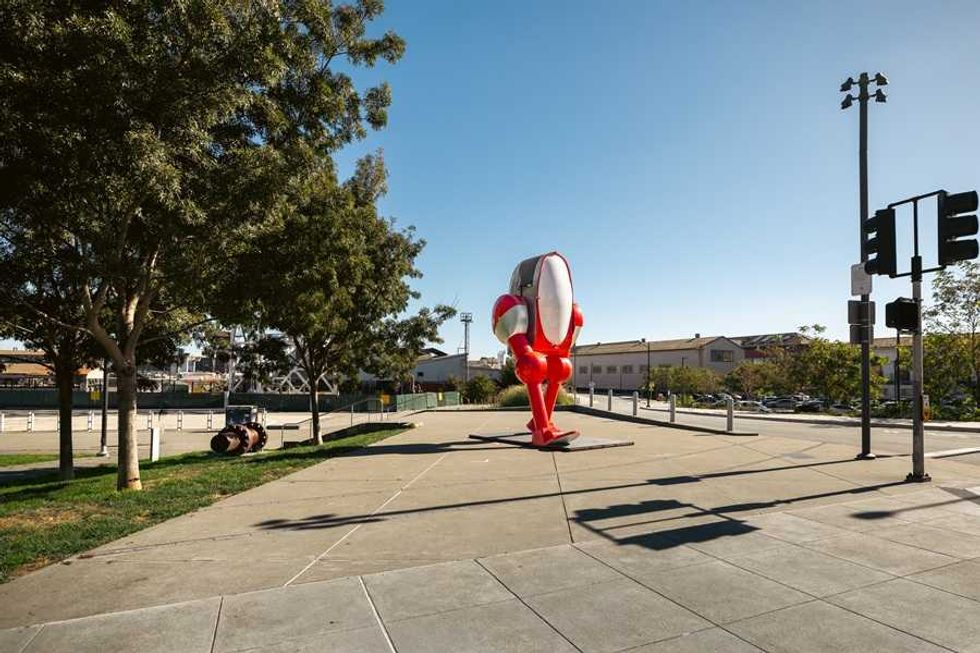 Dr. Fisherian(Masaki Omor)