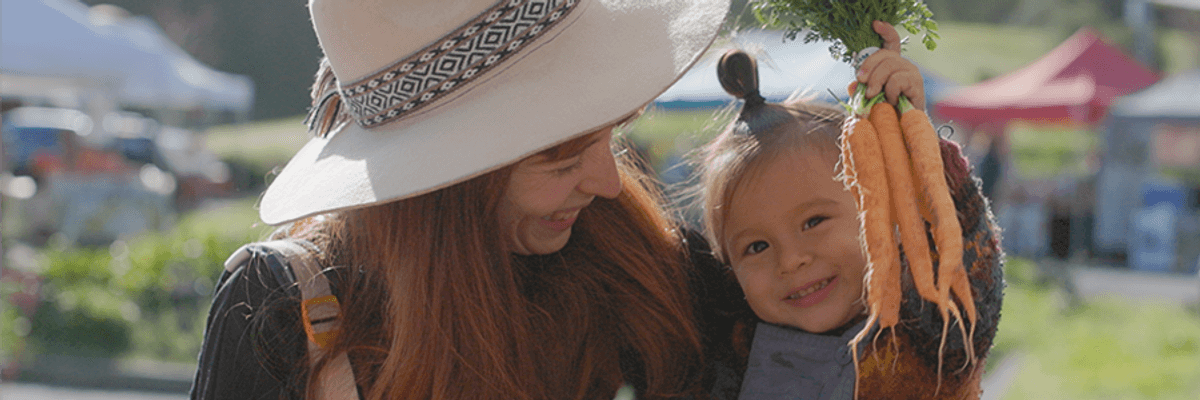


Jennifer Banzaca spent years working as a graphic artist in children’s publishing and entertainment at places including Golden Books, Nickelodeon, and Disney.
The work informed her sense of color, inspiring her to add bright pops of yellow, pink, and green to the pieces now on display at High Pile: Concepts in Tufting at Walnut Creek’s Bedford Gallery.
During the pandemic, Banzaca, who began painting in 2012, started seeing people tufting online. Something about the technique of pushing yarn through fabric fascinated her. She got a kit and paid $30 for a series of videos by Trish Anderson (whose work is also in the exhibition) to learn how to do it.
It was a little bit of an angel-and-devil situation, Banzaca remembers. The red guy with the horns was telling her she would never do it, that she didn’t finish what she started, while the part of her conscience with her best interests at heart said she should give it a shot. She listened to that one.
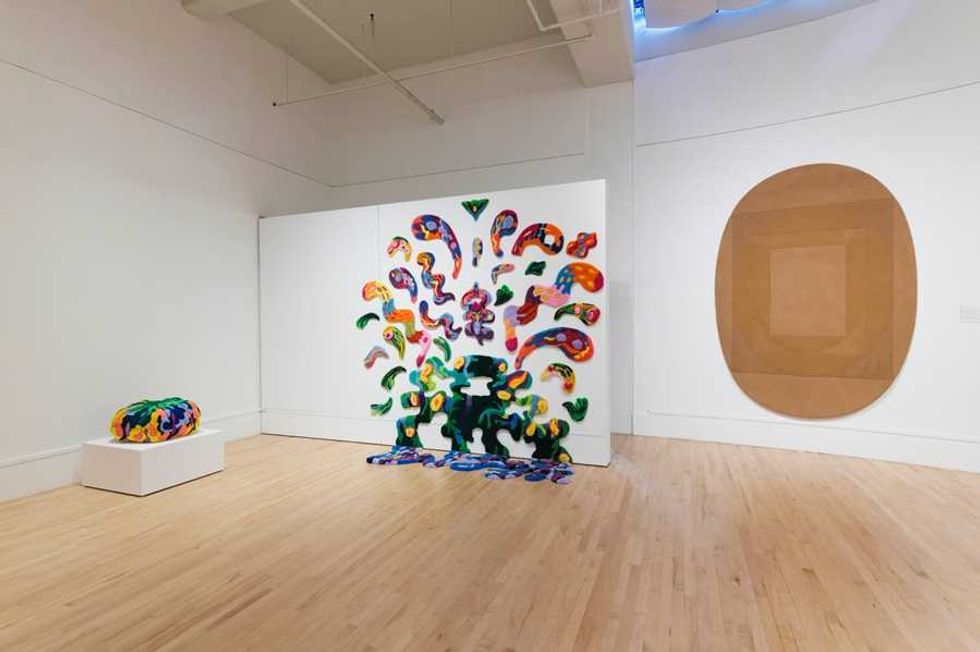 Work by Jennifer Banzaca in 'High Pile'(Courtesy of Bedford Gallery)
“It’s just very satisfying because you're painting with yarn,” Banzaca says. “I really enjoy the craft element, and that's kind of a dirty word in the art sphere. You have this sense of ‘I made this thing and it's tactile and it absorbs sound.’ I don't have to be a rectangle or a square anymore; it's spun me off into different mixed media. So, now I'm combining tufted material with painted wood.”
Banzaca’s work in the show gets away from quadrilateral figures, as in the mural Rise Up! and Garden Pouf, an experiment in soft sculpture which she compares to a beanbag chair held together with yarn and a prayer.
That idea of craft being a dirty word is something that animates Emilee Enders, the curator of the show, too. She’s on a mission to change that preconception.
“Largely craft is and has been labeled as women's work and therefore devalued and not considered in larger conversations, and not given its due,” she says. “We're always looking at the creative new ways that people are using textiles or ceramics or whatever it might be and trying to evolve that conversation into a fine art conversation.”
Pieces by the 20 artists in the show include Depressed Kitten, an extremely adorable cat with a befuddled expression and a blue bow on its head, by Maja Michaelsdotter. But the tufted art goes way beyond cute and colorful, with Vanessa Barragão’s Submersos focusing on the ecology of the oceans; two pieces from Mychaelyn Michalec—All my geese are swans 2 and Knock on Wood—which explore feminism and gender issues; and Johannah Herr’s bright pieces dealing with gun violence, American War Rug III (El Paso Shooting) and American War Rug IV (Las Vegas Shooting).
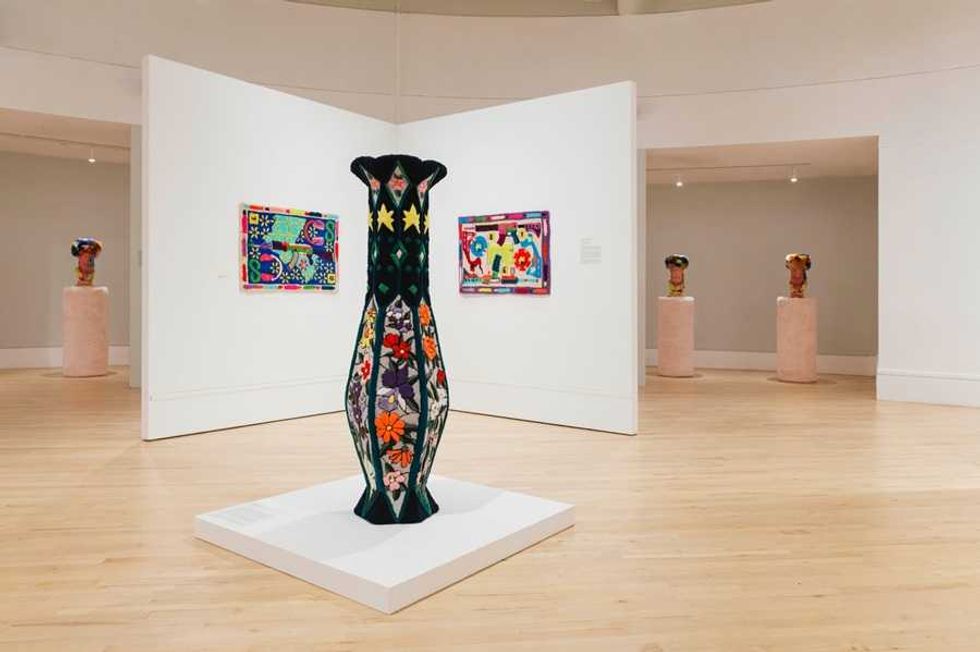 Work by Johannah Herr in 'High Pile'(Courtesy of Bedford Gallery)
Herr makes wallpaper, artists’ books, and collages, and works with Thai anti-trafficking NGO Daughters Rising, using “subversive, color-saturated objects, and maximalist installations to critique state-sanctioned violence in the United States.” She came to tufting in an unusual way.
While visiting her best friend in China, artist Xinan Ran, the two went to a large textile factory that made the rugs for the Beijing Olympics, among other things. Both of them loved seeing the process and wanted tufting guns. They weren’t for sale, but people at the factory gave them floor models.
Herr, whose work involves lots of research, wasn’t sure what she wanted to do in the medium for a couple years. Then, in 2020, she hit on it. In graduate school, she had researched Afghan war rugs in which people started incorporating military iconography into their designs after the 1979 Soviet invasion. Herr decided to make her own version.
“What if I kind of inserted myself into this craft tradition because as an American, I'm already there, right?” she says. “Tax dollars have already inserted me into this, so that was the first time I was like, ‘OK, I'm going to make my own war rugs,’ and so that was the beginning of the body of work.”
Besides mass shootings, Herr’s rugs also explore incarceration, immigrant detention, and police brutality. Tufting is a good medium for these topics, Enders thinks.
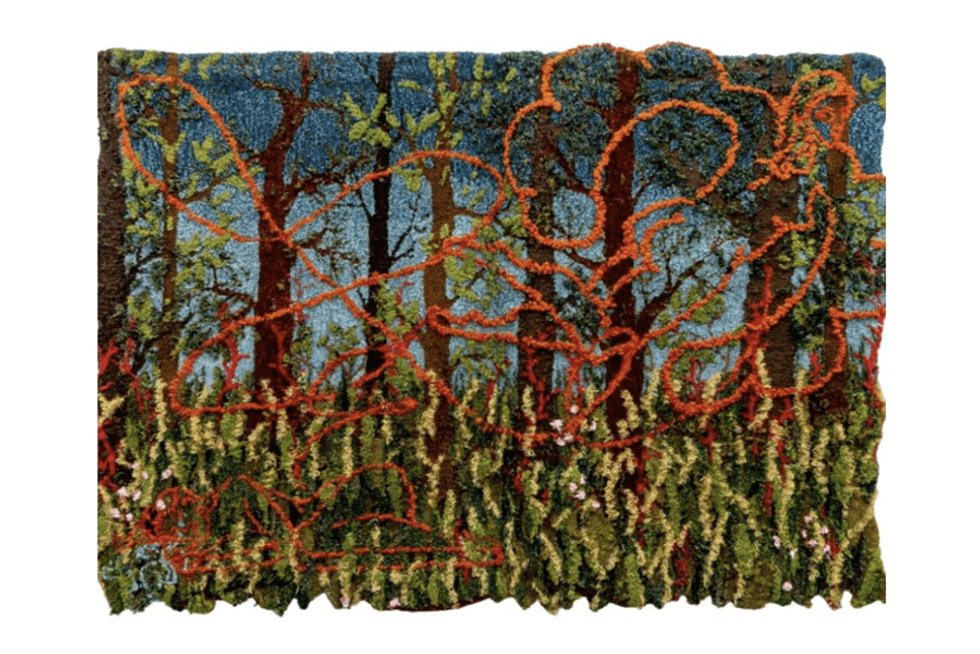 One of the works on display at Bedford Gallery's 'High Pile' by Sam Durant(Courtesy of @bedfordgallery)
“You actually take a deeper look, and you realize that these are very intense subjects that deserve time and attention and you've been pulled in through the visual aesthetics of tufting,” she says. “Now you're invested in learning about what the artist is trying to tell you through this medium. It also has this really tactile element that draws people in, and while you can't touch it, you still are curious about what's happening in the piece.”
Herr agrees. A rug is familiar and you’re already involved before you can intellectualize it, she says.
“With my work, you think you're getting Froot Loops and it's really like Raisin Bran without the raisins. If you feel like you have to have a certain level of academic experience to be able to engage with those works, I think it pushes out a lot of people who otherwise could be welcomed in to have interesting conversations.”
// ‘High Pile: Concepts in Tufting’ is on display at the Bedford Gallery through December 13th; Lesher Center for the Arts, 1601 Civic Dr. (Walnut Creek), bedfordgallery.org