

On a recent episode of the podcast Pivot, host Kara Swisher mused to her guest co-host about who she would like to design the Oval Office if she were president.
Her choice? San Francisco designer Ken Fulk, whose style she described as louche with a little too much velvet.
That style is on display at Saint Joseph’s Arts Society, which Fulk founded in 2018, turning the former Romanesque church into a glamorous, massive art space south of Market. Looking around on September 12th, the opening night of La Pocha Nostra’s The Other Art World, it seems that for Fulk, there is no such thing as too much velvet.
That’s also true for the members of La Pocha Nostra, an arts collective founded in 1993 in Los Angeles by Guillermo Gómez-Peña and now based in San Francisco, with Gómez-Peña and Balitronica as co-artistic directors. The maximalism of the former church, full of patterned drapes, hidden spaces, and velvet couches, goes well with the maximalism of La Pocha who, on opening night, put on the roving performance The History of Art in 15 Minutes with music, songs, poetry, and special appearances by Flower Piano Festival musicians.
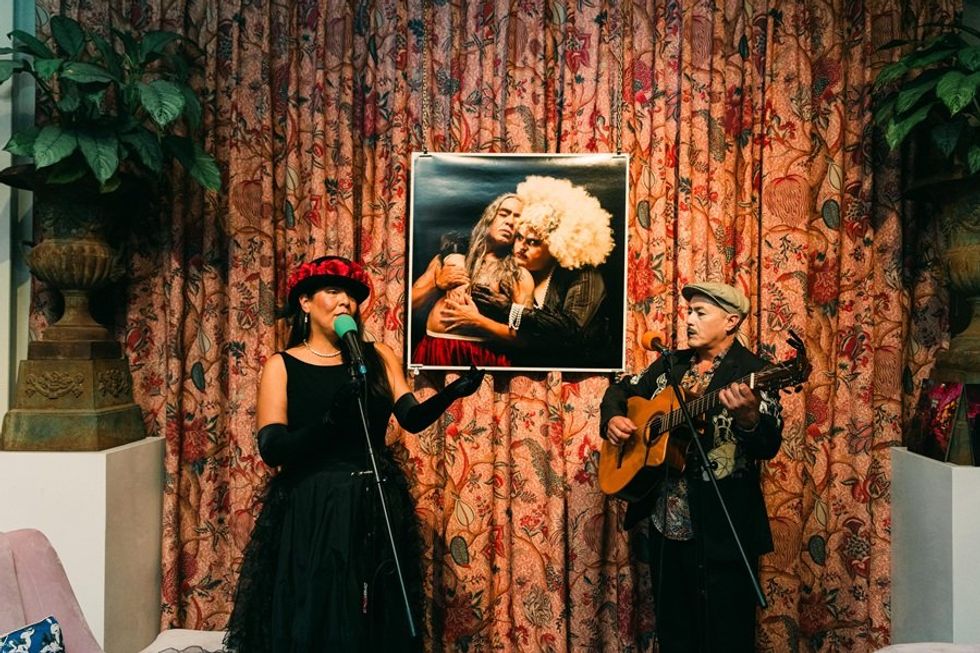 An performance at the opening night of 'The Other Art World - La Pocha Nostra'(Jackson Courtney, Saint Joseph's Arts Foundation)
This desire to do it all is another thing La Pocha Nostra has in common with Saint Joseph’s, which along with hosting arts events like this one, also does residencies, readings, film festivals, and mahjong nights.
Francisco Orrego—who read his poem Liquid Wreck wearing a tie, jacket, and black cartoon-robber-style mask—met Gómez-Peña by chance at City Lights Books one night a couple of years ago, and is a collaborating artist, currently working with them on the film, Rancho Noir. He loves La Pocha.
“No boundaries is fantastic. It applies to everything in life, from gender to politics to actual borders,” he says. “It transcends all of that, and that’s pretty exciting.”
That fluidity also appeals to Martin Strickland, the director of Saint Joseph’s and curator of the exhibition. Having one of the longest-running arts collectives in San Francisco speaks to the city’s collaborative and experimental nature, he says.
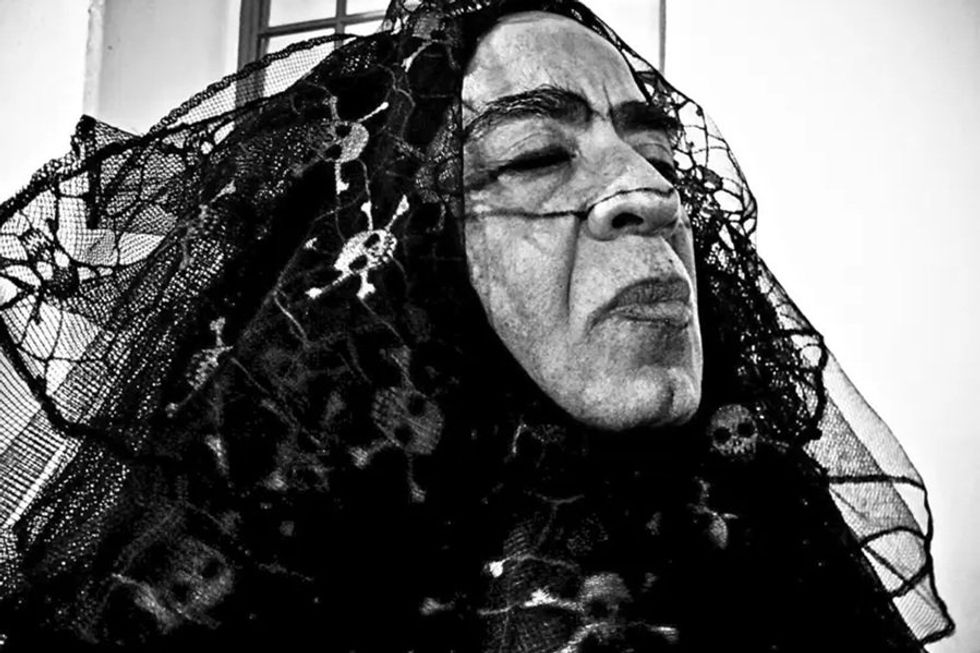 La Pocha Nostra founder Guillermo Gómez-Peña(Courtesy of La Pocha Nostra)
“I feel like I learned what it means to think about being an artist from [Gómez-Peña]. It’s sort of pushing forward all of the artistic desires that come into one's brain and finding an outlet for them, and never really being deterred by either time or place.”
Sitting on one of the velvet couches in a reading nook, Emma Tramposch, executive director of the group's nonprofit and curator of La Pocha’s Living Archives, says she’s equally taken with Saint Jo’s and the way they encourage dreaming big.
Some items from those archives are on display now, including paintings from the Velvet Hall of Fame, Photo-Performance—a series that turns the photographer into a collaborator and the camera into a stand-in for the audience—and ephemera from Performabilia/Borderabilia. It fits in well there, Tramposch says.
“There are some things in here where it’s like, ‘Is that Guillermo Gómez-Peña’s, or is that Saint Joseph's?’” she said. “Not every space offers this kind of Baroque and maximalist feel that he really loves. Then that’s also matched with a real sense of nurturing artists and caring for artists. Radical hospitality is a big deal for us, and they have that here. We're big fans.”
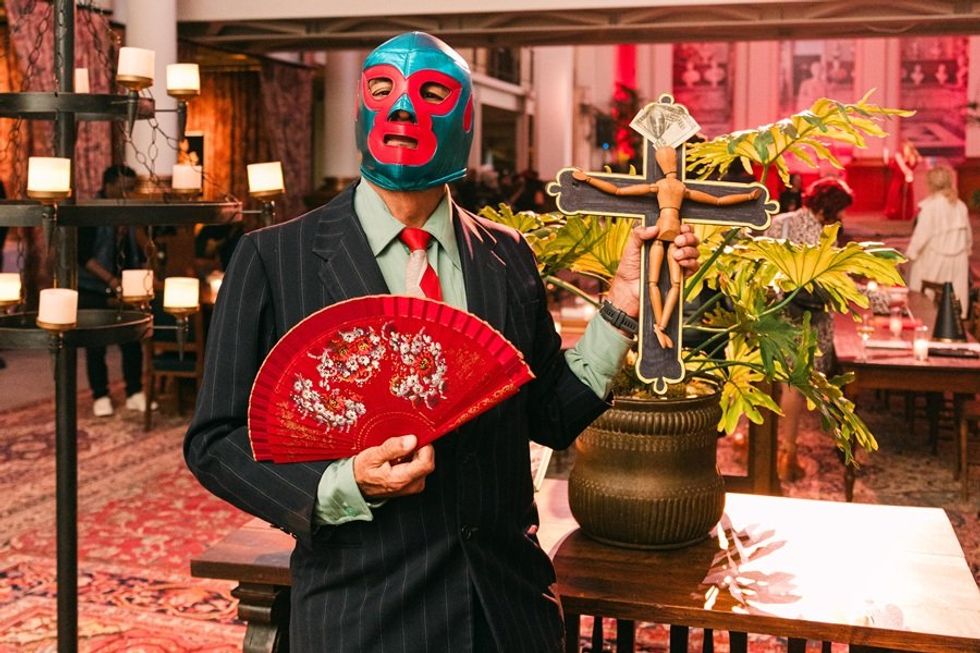 Opening night at 'The Other Art World - La Pocha Nostra'(Jackson Courtney, Saint Joseph's Arts Foundation)
Like Orrego, artist Jamil Hellu loves that the collective’s stated mission is “erasing the borders between art and politics, art practice and theory, artist and spectator.” Hellu, a lecturer in photography at Stanford University, says that with all the political focus lately on immigration, this exhibition feels particularly important.
“There's a constant iconography of Mexican and United States flags. He activates a lot of different people, a lot of different performers, which enhances the work. I relate to that a lot because I think about it so much in my work, so I feel very connected to how he's expressing himself through collaboration with others.”
Hellu’s husband, Darrin Martin, the chair of video and media arts at the University of California, Davis, has followed Gómez-Peña’s work since the ‘90s.
“The context of this in a church is really interesting because he and his collaborators embrace queer, gender nonconforming, all races, and ethnicities; they embrace disability,” he says.
“I feel they are, in a lot of ways, the big umbrella reflection that is the only way to fight back, and it's the only way we can move forward and actually be a power against what we're up against right now.”
// 'The Other Art World - La Pocha Nostra' is on view at St. Joseph's Art Society through December 12th; 1401 Howard St. (SoMa), saintjosephsartssociety.com