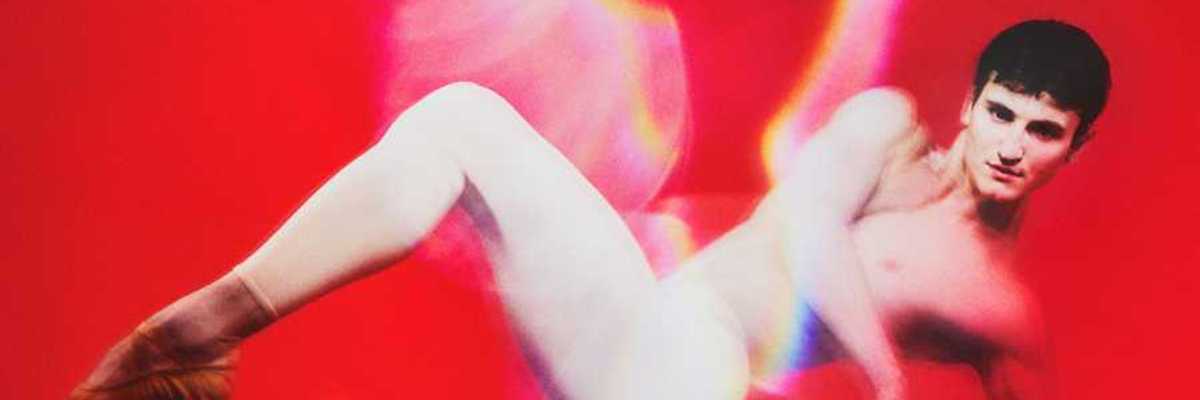

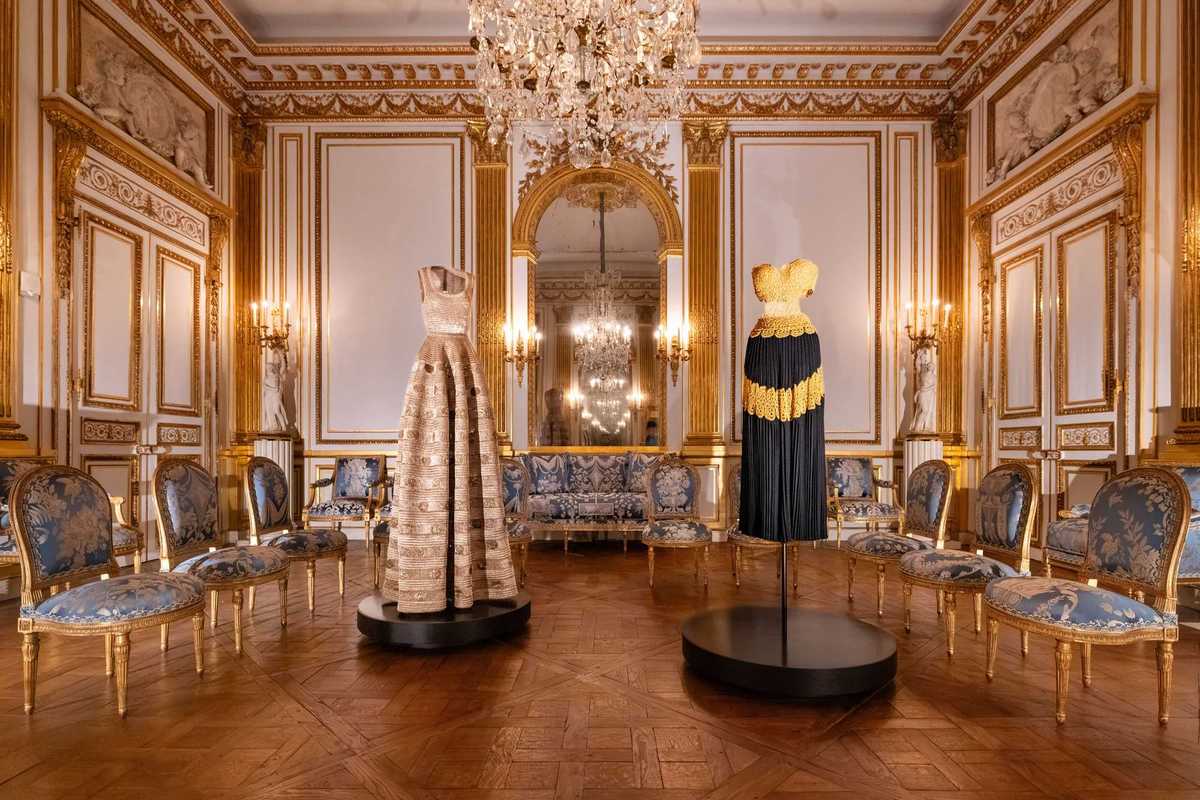
Amid relentless fast-fashion cycles and disposable social media trends, it is worth revisiting an icon who defied the traditional fashion calendar, and whose work designers still reference today.
The Tunisian-born couturier Azzedine Alaïa prized craftsmanship above all else, creating body-conscious designs famously walked by Naomi Campbell, Linda Evangelista, and Cindy Crawford.
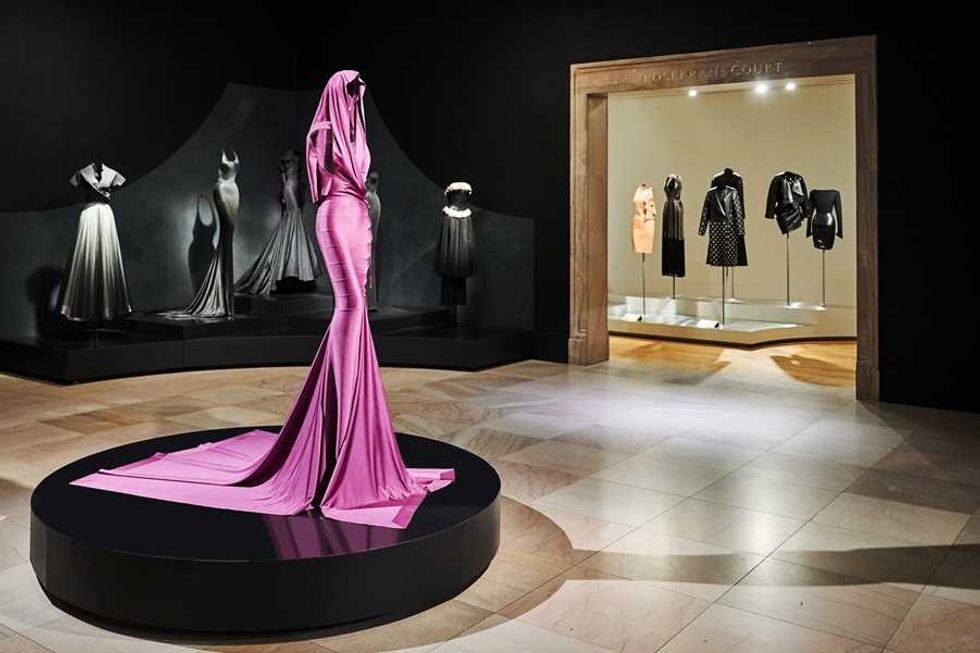 Installation view of "Azzedine Alaïa: Sculpting Fashion," at the Legion of Honor Museum, San Francisco, 2026. (Randy Dodson, courtesy of the Fine Arts Museums of San Francisco)
To Alaïa, true luxury required no announcement; he let the rigor of his craft speak louder than any logo or commercial spectacle. Trained as a sculptor at Tunis’s École des Beaux-Arts (now the Institut Supérieur des Beaux-Arts), Alaïa approached fabric like marble, draping textiles directly onto the body with an intimate fluency in female anatomy that celebrated every curve.
Now, Azzedine Alaïa: Sculpting Fashion at San Francisco's Legion of Honor explores the designer’s enduring influence across the United States, charting a trajectory that began with 20 years as an intimate Parisian dressmaker before his landmark 1980 debut.
Alaïa’s American breakthrough arrived in 1981, when the renowned photojournalist Bill Cunningham photographed top French fashion editors in his sculpted, curved-zipper leather suits and grommet-studded black accessories. Featured in the November 23rd issue of Women’s Wear Daily under the headline “Paris’ New Hot Name,” the spread sparked an immediate transatlantic sensation.
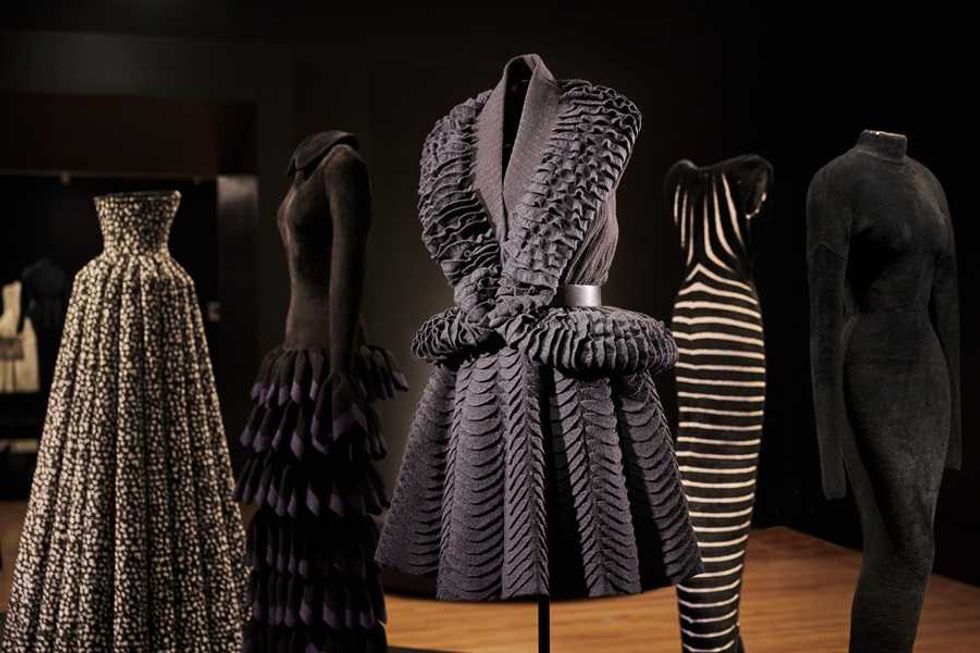 Installation view of 'Azzedine Alaïa: Sculpting Fashion,' at the de Young Museum, San Francisco, 2026.(Randy Dodson, courtesy of the Fine Arts Museums of San Francisco)
1985, when popular media crowned him the “King of Cling” following an unforgettable runway spectacle at New York’s Palladium nightclub, marked a turning point for Azzedine Alaïa. Sponsored by Barneys New York with a set designed by Jean-Paul Goude, the event saw more than 50 models present three years of his work before a crowd of over a thousand guests. Later that year, at the Palais Garnier in Paris, the Fédération de la Haute Couture et de la Mode awarded him two Oscars de la Mode for Best French Collection and Best Designer of the Year.
Today, visitors to Sculpting Fashion can see an artifact from that triumphant night: the Spring/Summer 1986 Haute Couture acetate jersey dress Grace Jones modeled on the runway and wore to the awards ceremony. Those early body-hugging jersey experiments reached their technical peak in his Spring/Summer 1990 Haute Couture collection, with the debut of the iconic bandelette (bandage) dress. Constructed from dense, knitted strips of viscose, polyamide, and elastane, the garments wrapped the torso in architectural spirals that supported the body without a single stitch of traditional corsetry.
"The bandage dresses represent the culmination of his technical virtuosity, in the way that they hug the body and emphasize the female form," notes Laura L. Camerlengo, curator in charge of costume and textile arts at the Fine Arts Museums of San Francisco. "They developed for about a decade, and the 1990 collection in particular represents the culmination of those ideas. He drew inspiration from Egyptian mummies, the meticulous wrappings of the body, and we see it translated in the materials he uses, as well as his technique in draping, or bias-cutting at 45-degree angles, onto the wearer's body."
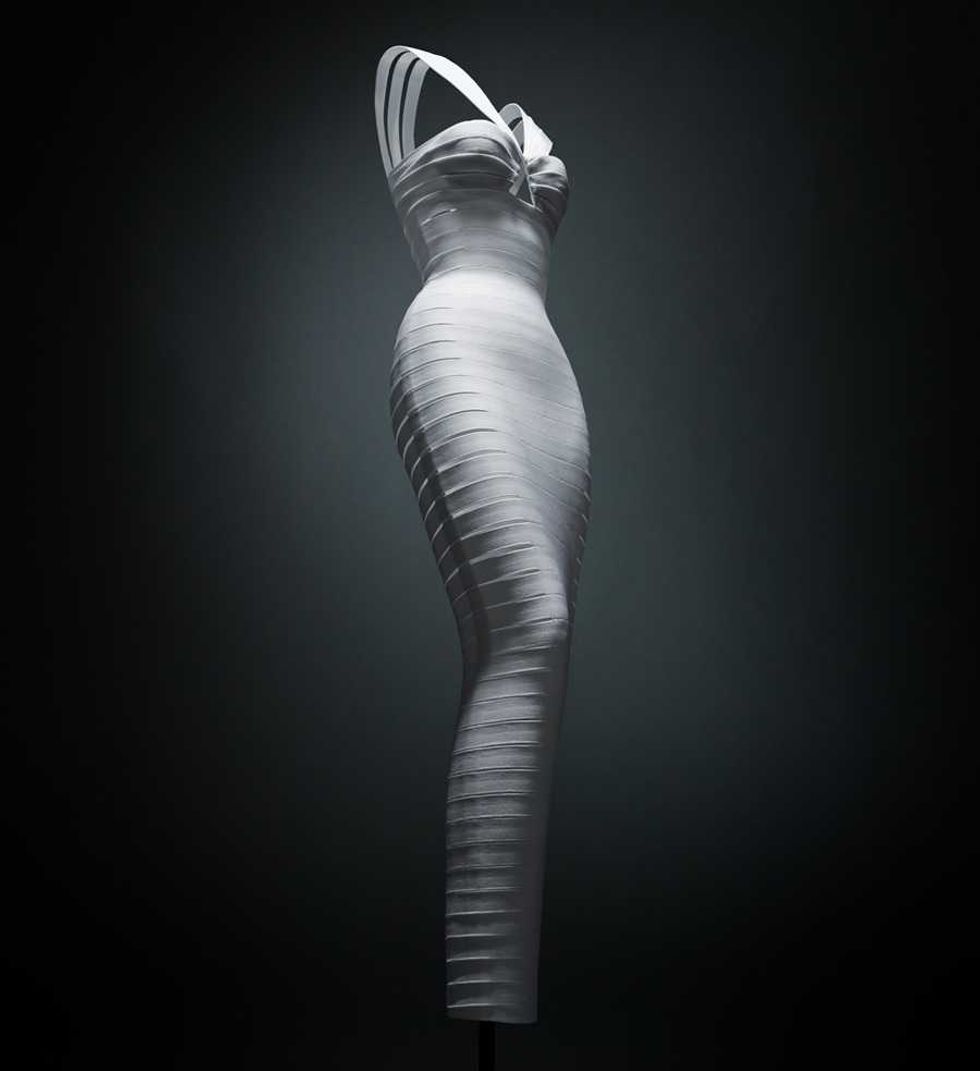 Azzedine Alaïa (1935–2017), dress, Spring/Summer 1990 Haute Couture. Viscose, polyamide, and elastane.(Courtesy of Fondation Azzedine Alaïa. Photograph © Andrea & Valentina)
Remarkably, 1985 also marked Alaïa’s museum debut, when the CAPC Musée d’Art Contemporain de Bordeaux staged Une journée avec Azzedine Alaïa: Mode 1980–1985. Even as institutions began to canonize his work, Alaïa remained anchored by his Paris atelier and the devoted sisterhood of muses who gave his silhouettes life. Supported by early confidante Farida Khelfa, who wore his designs on the runway and worked beside him in his studio throughout the 1980s, Alaïa fostered an unshakeable bond with the women who walked for him.
In 1986, iconic supermodel Naomi Campbell, Alaïa’s longtime muse and protégée, made her runway debut for the house. “‘I don’t care how long I have to stand to be pinned into one of his dresses, because watching him create is mindblowing,” Campbell recalls in the exhibition catalog. “He still does all the construction work himself. You used to see photographers like Arthur Elgort, Bruce Weber, and Ellen von Unwerth backstage at his shows because they were interested in capturing him at work. No one can do what he does, which is why whenever he announced a show, every one of us—Cindy, Christy, Linda, Iman, Yasmin, Claudia [Schiffer], Elle [Macpherson], Eva [Herzigova]—would make sure we were there.'"
In 1987, Alaïa acquired 18, Rue de la Verrerie in Paris’s Marais district, a sprawling complex where King Louis XV’s celebrated mistress, Madame de Pompadour, had once been educated. Captivated by the building's past, he wove 18th-century grandeur into his Spring/Summer 1992 collection, pairing historicized silhouettes with irreverent knits patterned in tattoo-like motifs. On the runway, his muse Naomi Campbell wore a memorable knit dress emblazoned with “Mon cœur est à papa” (“My heart belongs to papa”), a witty tribute to the paternal bond between designer and model that visitors can see up close in the exhibition.
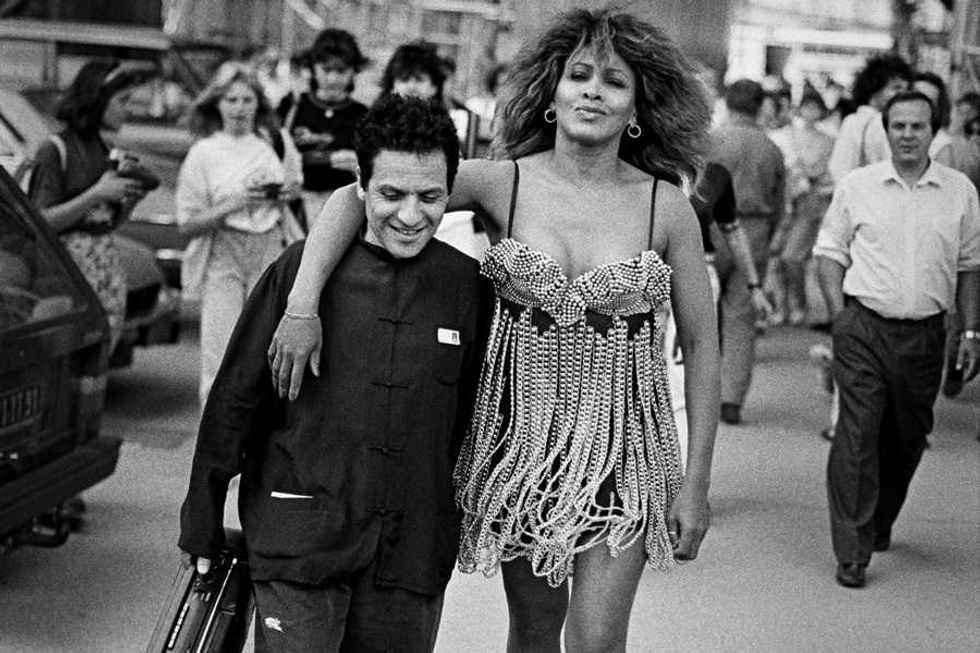 Azzedine Alaïa and Tina Turner, Paris, 1989 (Peter Lindbergh, courtesy of the Peter Lindbergh Foundation, Paris)
In one leather dress from his Fall/Winter 1993 Haute Couture collection, currently on display at the Legion of Honor, intricate hand-cutwork gives movement to taut black leather, parting to reveal flashes of colored layers underneath. As Olivier Saillard, fashion historian, exhibition co-curator, and director of the Fondation Azzedine Alaïa, notes in the catalog, the technique echoes the mashrabiya, the carved lattice screens outside North African homes from Alaïa’s childhood that filtered light and air while simultaneously revealing and concealing domestic space. Translated to the body, that architectural interplay of light and shadow transforms heavy leather into something breathable and kinetic. Across his career, perforated leathers and metals became his signature and recurring vocabulary, stretching from his earliest American presentations all the way to his final Paris haute couture show in 2017.
Notably, the exhibition culminates in an electrifying finale featuring archival looks worn by Tina Turner, while additional haute couture pieces tucked throughout the museum’s permanent collection galleries illustrate the artistry and sculptural genius of Azzedine Alaïa. Among the highlights is a dress worn by Turner from his Spring/Summer 1989 Haute Couture collection that’s crafted from sheer silk organza and gold-tone steel beads. A close friend and creative confidant, Alaïa famously dressed Turner during her triumphant Private Dancer comeback era, evolving a stage wardrobe that had first captivated fashion audiences through her iconic Bob Mackie fringe costumes of the late seventies.
// ‘Azzedine Alaïa: Sculpting Fashion’ is on view from November 21st through April 11th at the Legion of Honor; 100 34th Ave. (Outer Richmond), famsf.org
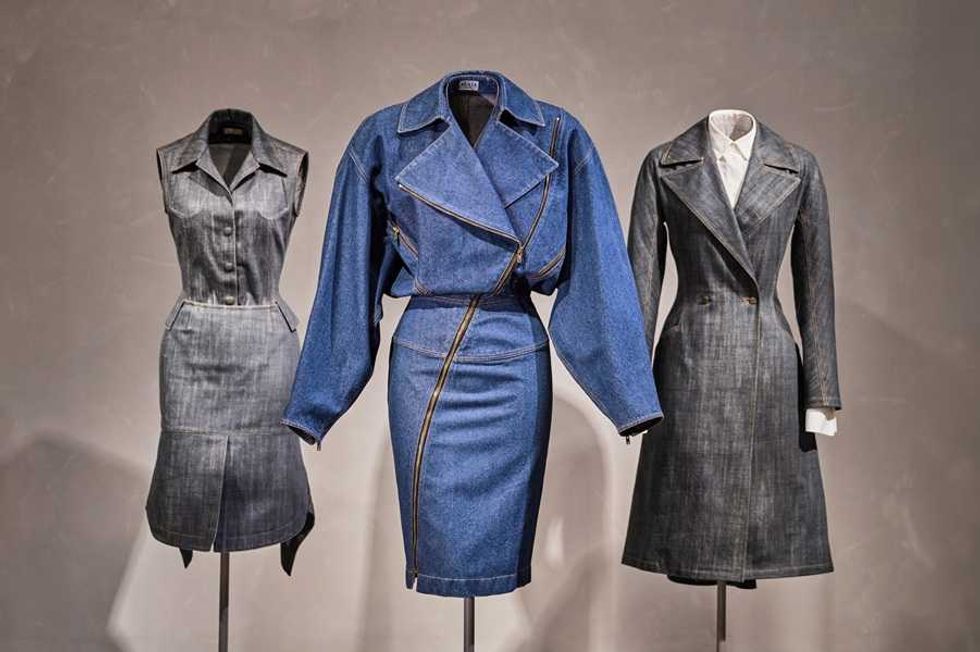 Installation view of 'Azzedine Alaïa: Sculpting Fashion,' at the de Young Museum, San Francisco, 2026 (Randy Dodson, courtesy of the Fine Arts Museums of San Francisco)