

In 2013, artist Lava Thomas found an old album in the piano bench of her grandma’s Los Angeles house while she was looking for sheet music (her grandmother was a church choir director and pianist). She had never seen the album before.
Paging through the album, it started crumbling in her hands from age. She turned to the photographs of two women and knew right away what she wanted to do.
“The women were very different, had very different expressions, and were from different time periods,” says Thomas. “One of them had this powerful direct gaze that met me with so much force, I literally gasped. It took my breath away, and I knew I wanted to draw them, and I knew immediately that I wanted to draw them big.”
Drawings that Thomas did of those two women, titled Looking Back 1 and Looking Back 2, were part of an exhibition at the Berkeley Art Center in 2015. Now, more monumental drawings of Thomas’s Texas ancestors, as well as documentation of their lives, make up Lineage, her first solo exhibition at Jessica Silverman.
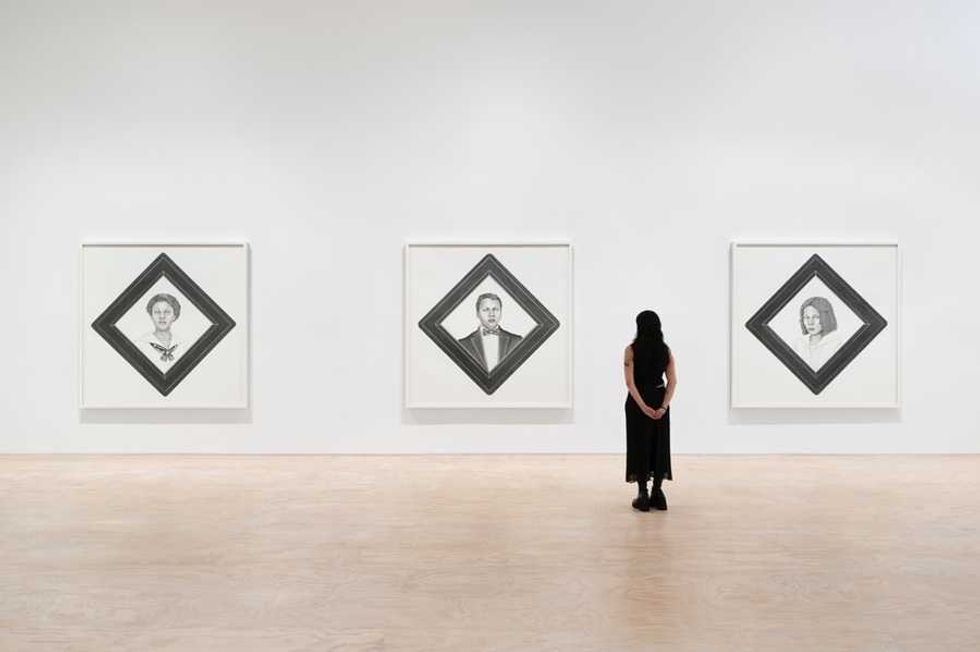 'Lava Thomas: Lineage' is on display at Jessica Silverman Gallery in San Francisco through October 24th.(Phillip Maisel)
Thomas works in different mediums, including public art, such as Portrait of a Phenomenal Woman, the statue of writer Maya Angelou outside the main branch of the San Francisco library—and installations like her hundreds of pink tambourines with quotes by women such as Sojourner Truth in Resistance Reverb: Movement 1, on view at the Obama Presidential Center in Chicago. But drawing is her favorite. Thomas says she was blessed with an innate talent for it, which the precise and moving portraits in Lineage make clear.
Thomas has drawn since she could wrap her fingers around a writing implement, and it’s a medium she always returns to.
“I like the accumulation of thousands upon thousands of lines. I like its meditative quality,” she says. “l also like the fact that it's an accessible medium, and most everyone across class, education, and geographical boundaries, has held a pencil in their hand.”
Like most of Thomas’ work, the drawings in the show are made with graphite and Conté crayon, sometimes with charcoal and watercolor added. Thomas, who keeps multiple sharpeners, both electric and manual, in her studio for her pencils, says the combination of these gives her both control and the kind of dark marks that can be seen across the room.
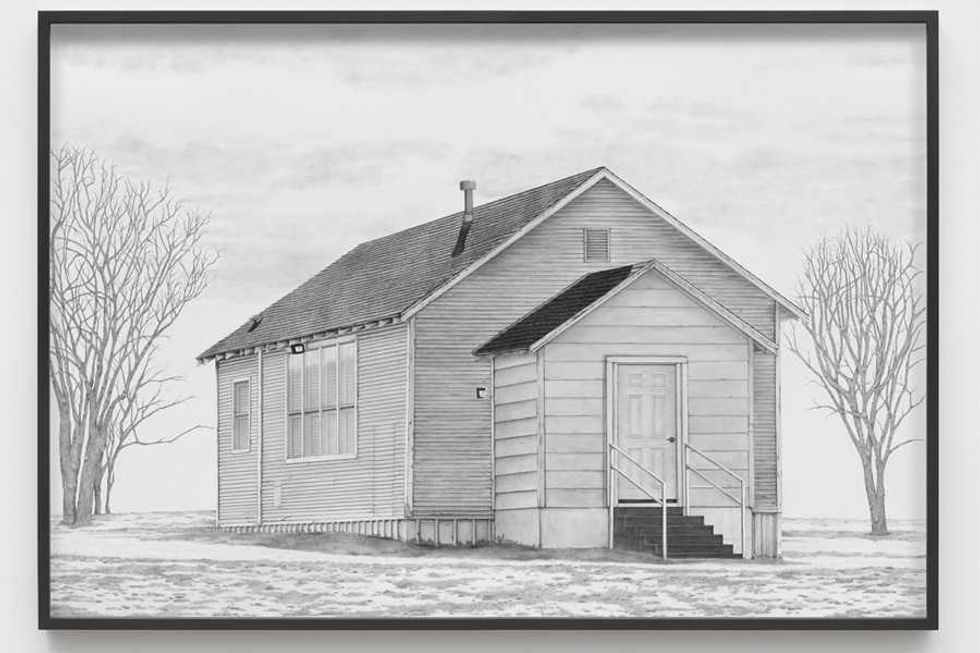 Lava ThomasEast Side Elementary Schoolhouse, 2026 Graphite and Conté pencil on paper(Phillip Maisel)
Thomas has used these materials with precision and care to create works of her Texas ancestors like Grace and Bearing, 2026, which shows a woman sitting in a chair. Her pearl necklace, the flowers on the table next to her, and her black shawl are rendered with incredible detail. I Stand Upright in My Own Regard, 2026, is a full-length portrait of a man. Thomas used charcoal for his double-breasted overcoat, which is textured like velvet. He stands next to a chair with a hat placed on it, looking at the viewer. Thomas used watercolor for the eyes, emphasizing his even gaze.
The show also contains Thomas’ first architectural drawing, East Side Elementary Schoolhouse, 2026, showing the one-room segregated schoolhouse in Decatur, the small town where her ancestors came from. Thomas’s grandmother had related stories about the town and the school (which she was instrumental in getting landmarked), and Thomas visited in 2019 when she was doing an artist residency in Fort Worth. She went to the Chamber of Commerce and explained she was doing research on her family and looking for landmarks her grandmother had told her about. The woman behind the counter pulled out a map and showed her where everything was.
The show also contains documents rendered so carefully it’s hard to believe they aren’t photos. They include the sign on the schoolhouse, birth and death certificates, and the Civil Rights Act of 1866.
 Lava Thomas Civil Rights Act of 1866, Unfinished, 2026 (Phillip Maisel)
Seeing her family’s history and portraits now on the walls of the gallery, Thomas says she feels a sense of exhilaration. Her emotions while spending hours making the marks to depict her ancestors included sadness for what her family had been through, as well as some understanding of the transformation from enslavement to emancipation and claiming their rights as citizens.
“My ancestors pursued those rights, particularly through education, through building and belonging to Black civic organizations, and their manner of dress—the way they presented themselves, the evidence of some financial stability, these ideas around aspiration and building families,” she explains. “I feel an enormous amount of pride drawing them and knowing that they were doing this in Texas during a time when the KKK was at its height. They were doing this against this backdrop of real racial violence, and they still managed to build lives and have homes and educate themselves and build some sense of financial stability.”
Her great-grandparents’ determination that their daughter, Thomas’ grandmother, go to high school led them to leave Decatur, where the school only went through the eighth grade. Thomas’ grandmother graduated as the valedictorian of her class.
The portraits of Thomas’ ancestors will also be on view in their home state when this show travels to the Amon Carter Museum of American Art in Fort Worth for Lava Thomas: In Our Own Regard on November 7th.
// ‘Lava Thomas: Lineage’ is on view at Jessica Silverman now through October 24th, 2026; 621 Grant Avenue (Chinatown), jessicasilvermangallery.com