
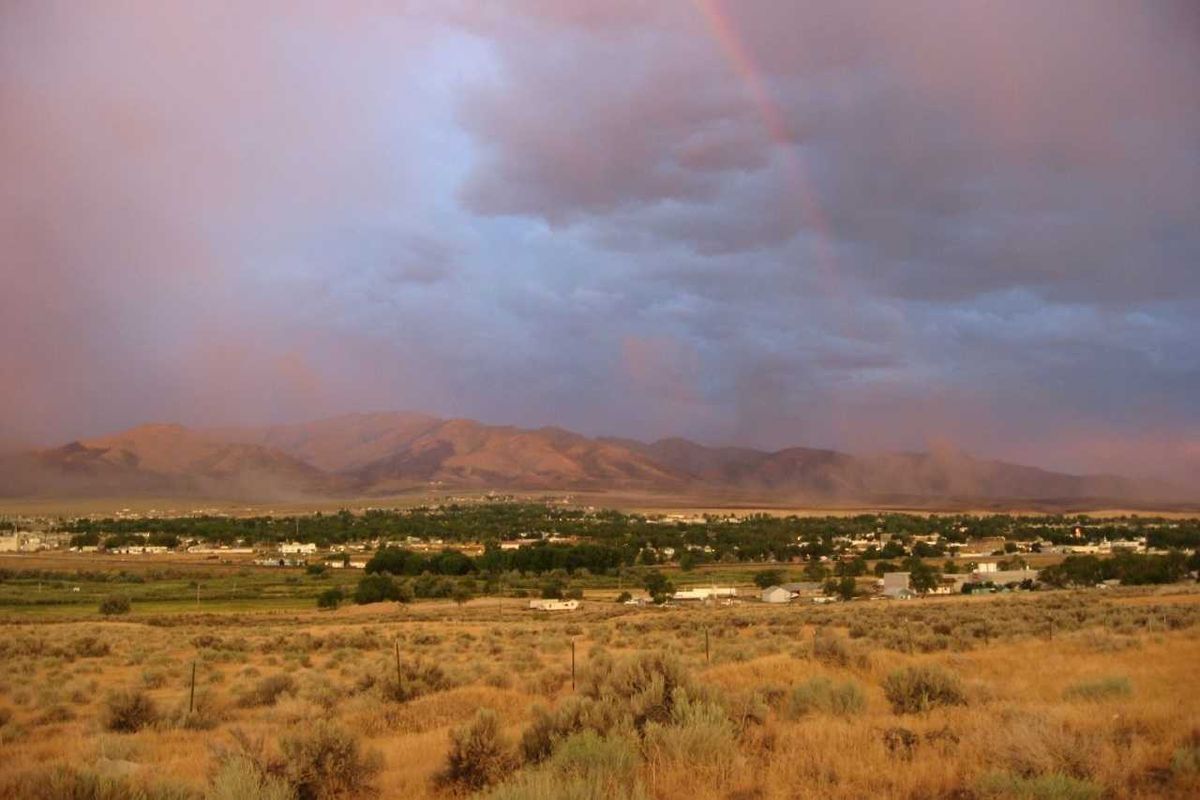
Interstate 80 through northern Nevada is one of America’s first “road trips,” a route mapped out by American settlers headed to California in the era of Manifest Destiny.
In many ways, Nevada hasn’t changed all that much since those days of typhoid and covered wagons. There’s still more desert sagebrush on these wide ranges than people—and that’s why it remains so iconic. It’s a place where the “West” lives on, resonating with a ranching culture and heritage so strong that the route has been christened the Cowboy Corridor.
If your experience with Nevada starts in Lake Tahoe and ends in Vegas, this road trip will show you a different side of the state. Don’t miss these nine essential stops along the Cowboy Corridor from Reno to the Nevada-Utah border’s Bonneville Salt Flats.
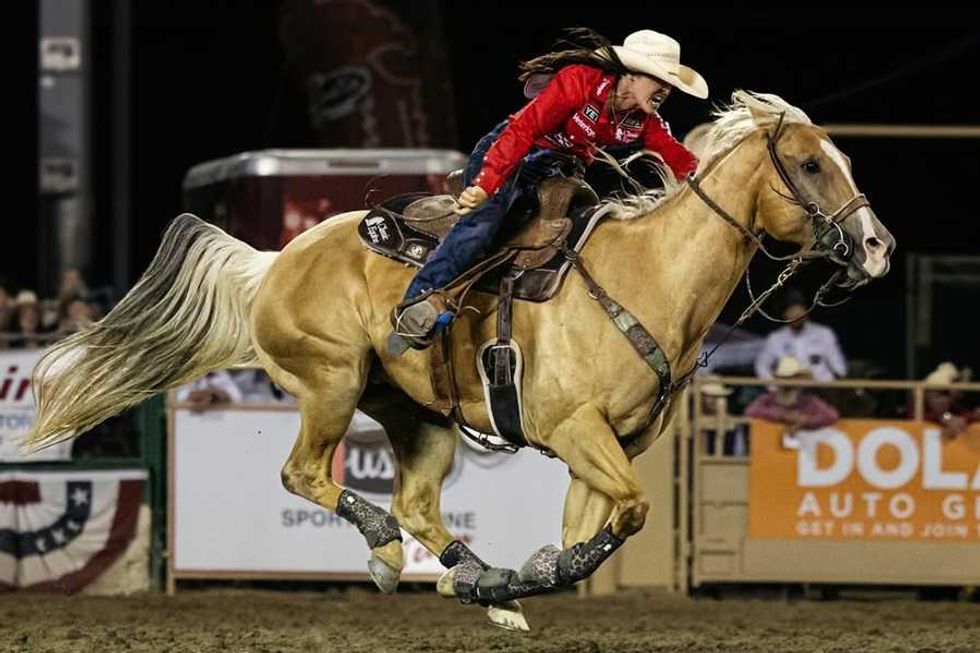 A barrel racer in full gallop at the Reno Rodeo(Courtesy of @renorodeo/@cowboychannel)
Stop 1: Reno
Reno is your entry point to the Cowboy Corridor. On the average day, the “Biggest Little City in the World,” about an hour east of Tahoe, tips its hat daily to Nevada horse and ranching culture with spots like the long-running Western apparel shop D Bar M Western Store (1020 E. 4th St.) and PJ & Co. (1590 S. Wells Ave.), a cowboy saloon with brunch and lunch dishes massive enough for a cowboy’s appetite. But only once a year does the town go all out in celebration of its living Western heritage at the Reno Rodeo. Known as the “Wildest, Richest Rodeo in the West,” the ten-day event is one of the largest in the U.S., with steel-nerved competitors vying for the prize money in bull and bronc riding, barrel racing, and other high-octane events that will literally have you up and out of your seat, howling with excitement. The 107th Reno Rodeo starts June 18, 2026 and tickets are already on sale.
Stop 2: Fort Churchill State Historic Park
Distance: 48 miles, 50 mins
It’s a short detour from Highway 80 to Fort Churchill State Historic Park, an abandoned army fort in the high desert. Built in 1860 to protect westward-emigrating Americans, the park is today a collection of ghostly adobe ruins so rarely visited there’s a solid chance you’ll be the only one wandering through them. // Take Hwy 80 to Hwy 439 S then Hwy 95A; 1000 Hwy 95A (Silver Springs), parks.nv.gov
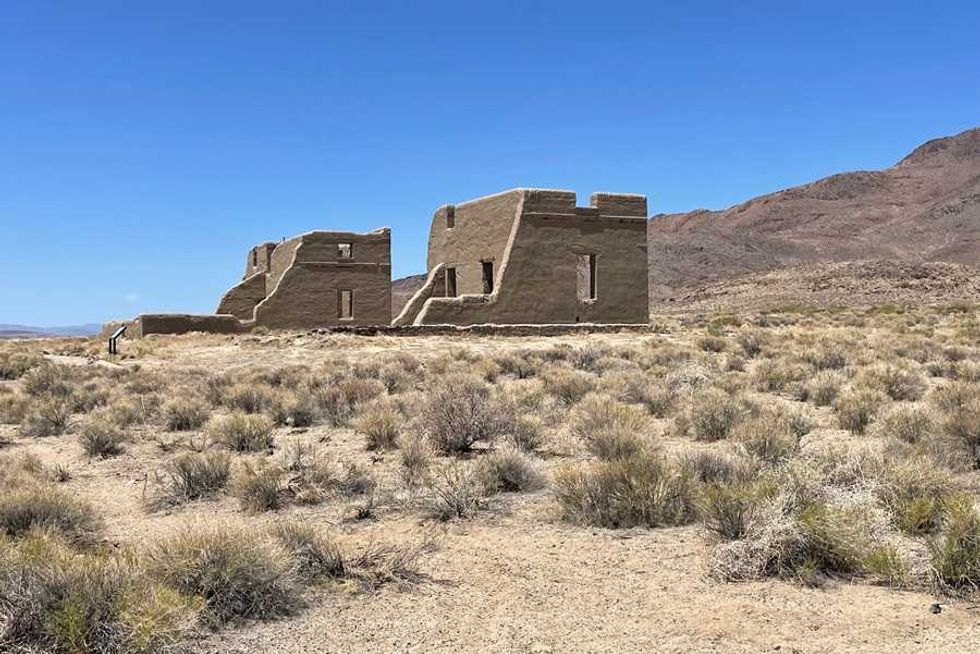 Fort Churchill sits abandoned in the Nevada desert(Shoshi Parks)
Stop 3: Salt Cave
Distance: 46 miles, 1hr
Before heading back to I-80, make a stop at Salt Cave. A limestone rock shelter on the edge of an ancient lakebed, this small, unmarked cave is literally covered in ancient red ocher pictographs made by the region’s early Indigenous inhabitants. There are certainly stories written among the handprints, wavy and dotted lines, and figures—though what exactly they say is up for interpretation. That’s the enigma of Salt Cave, one that will, more than anywhere else on this road trip, have you feeling like an explorer on a vast, virtually empty Western range. Don’t attempt to reach the cave in wet weather unless you have a 4WD, high-clearance vehicle. // From State Rte. 117, take Lima Ln. to Solias Rd., turn left on Lone Tree Rd., then follow these directions to map coordinates 39.33929 N, -118.93087 W; the cave is in the low hills to your right (Fallon), atlasobscura.com
Stop 4: Thunder (Lightning) Mountain Monument
Distance: 112 miles, 1hr 50 mins
The most unusual stop on this stretch of I-80, Thunder Mountain Monument (sometimes called Lightning Mountain) is an open-air sculpture garden and architectural marvel created by Creek Indian outsider artist Frank Van Zant. Van Zant began work here in 1969, partly to honor Native American spirituality and history, partly as protection against the apocalypse he anticipated was on the way. The entire thing is built of “junk”—car hoods, typewriters, gas pumps, and bottles formed into stained-glass windows—and although part of the site was destroyed by arson in the 1980s, what remains is open to the public for self-guided tours. It’s bizarre, wonderful, and 100 percent worth a stop. // Exit 145, I-80 (Imlay), travelnevada.com
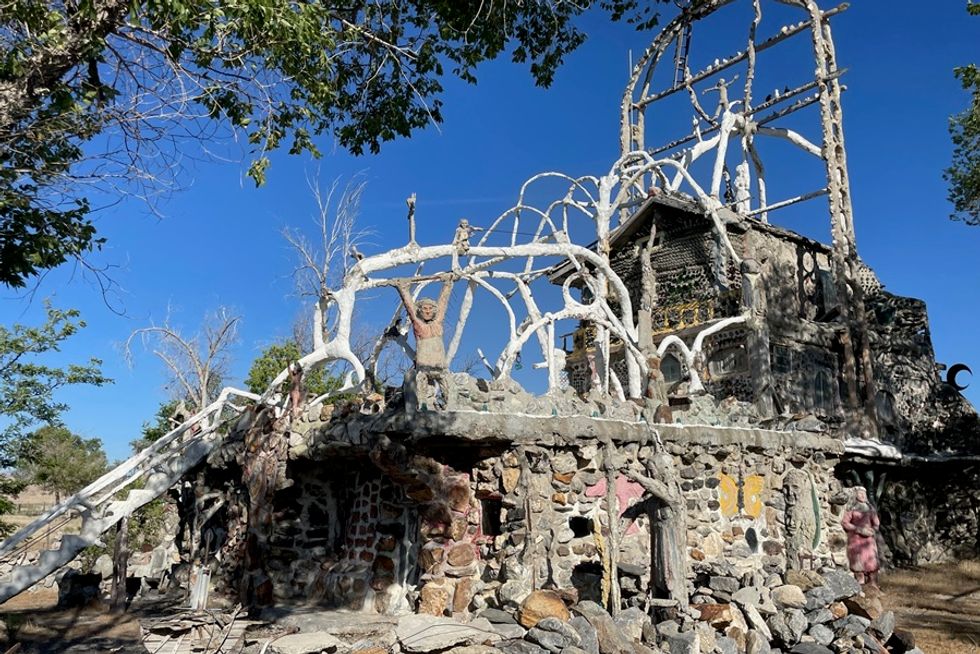 Thunder Mountain Monument(Shoshi Parks)
Stop 5: The Martin Hotel
Distance: 34 miles, 30 mins
Head back across the desert to Highway 80 and the sweet Americana of Winnemucca, the only actual city in the entirety of Humboldt County. This is the first stop on this trip you’ll get a taste of Nevada’s intriguing Basque history, a community that began forming in the mid-19th century with the arrival of thousands of immigrants in the gold mining and sheep herding trades. The Martin Hotel served as a boarding house and gathering place, with a family-style Basque restaurant downstairs. Eating there is still a one-of-a-kind experience. Be sure to try a Picon (sometimes called Picon punch), a signature Basque-American cocktail with amaro and brandy. // 94 W. Railroad St. (Winnemucca), themartinhotel.com
Stop 6: California Trail Interpretive Center
Distance: 115 miles, 1hr 30mins
The California Trail, the more southerly cousin of the famous Oregon Trail, was the path taken by thousands to the West Coast in the mid-1800s. The Interpretive Center in Elko gives a cinematic look at the challenges they faced along the way and the things they left behind. Don’t miss stretching your legs on a part of the original wagon trail, which was preserved when I-80’s construction destroyed most of the route. // 1 Interpretive Center Way (Elko), californiatrailcenter.org
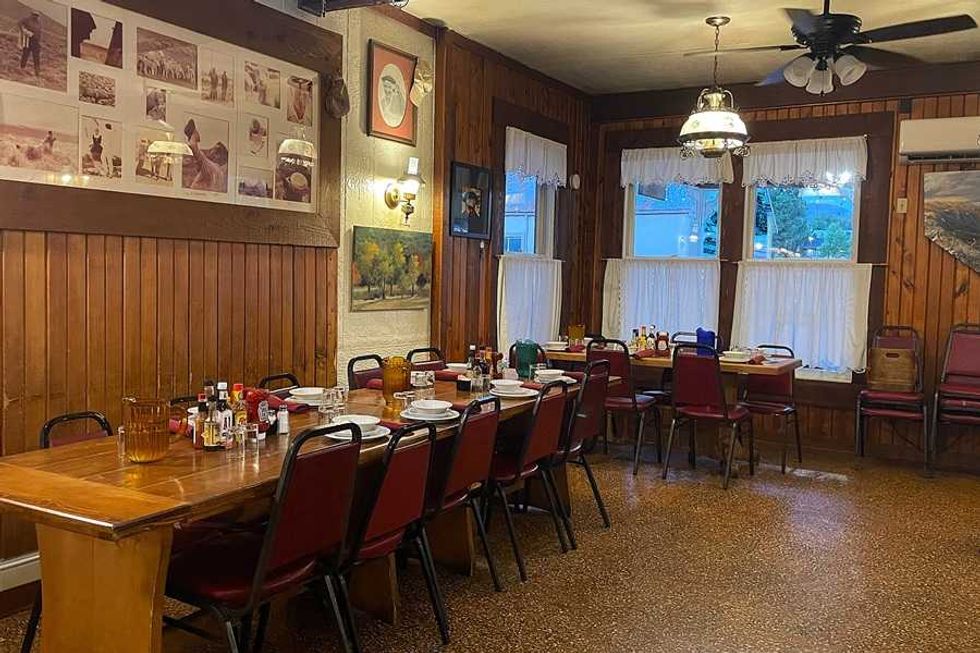 The no-frills dining room at The Martin Hotel(Shoshi Parks)
Stop 7: Elko
Distance: 12 miles, 15 mins
Northeastern Nevada’s largest town is a jumble of historic buildings, cowboy culture, and Basque heritage. The Western Folklife Center (501 Railroad St.), host of the annual National Cowboy Poetry Gathering, is here, as well as 100-year-old saddlemaker JM Capriola Company (500 Commercial St.), which shows off some of its historic work in its upstairs “museum.” The most interesting spot in town, though, is the Northeastern Nevada Museum (1515 Idaho St.), boasting a comprehensive look at the region since settler times (their handling of the pre-settler Indigenous era leaves much to be desired, to say the least) and shows off an oversized collection of taxidermied animals from around the world. The Star Hotel (246 Silver St.), a slightly different flavor of Basque restaurant than The Martin in Winnemucca, with a more boisterous crowd and a lively bar to go along with the giant, family-style meal is a must-do.Stop 8: Ruby Mountains Wilderness
Distance: 22 miles, 30 mins
After almost 400 miles of Nevada desert, the last thing you’d expect to find is an alpine landscape straight out of The Sound of Music. But just beyond Elko, there she is: the Ruby Mountains Wilderness, a stunning park of jagged peaks and sapphire lakes. The glacier-formed Lamoille Canyon is the state’s “Yosemite,” with 11,000-foot-tall mountains, hanging valleys, abundant streams, and intrepid mountain goats and bighorn sheep. There are lots of hiking trails here and several campsites if you want to spend the night (just driving through the canyon is lovely, too). If you prefer something a little less rustic, check out Ruby 360 Lodge (301 N. Mountain View Dr., Lamoille), a rustic lodge with excellent views, chef-made meals, and guided outdoor excursions that range from wakesurfing to trap shooting. // Ruby Valley, fs.usda.gov
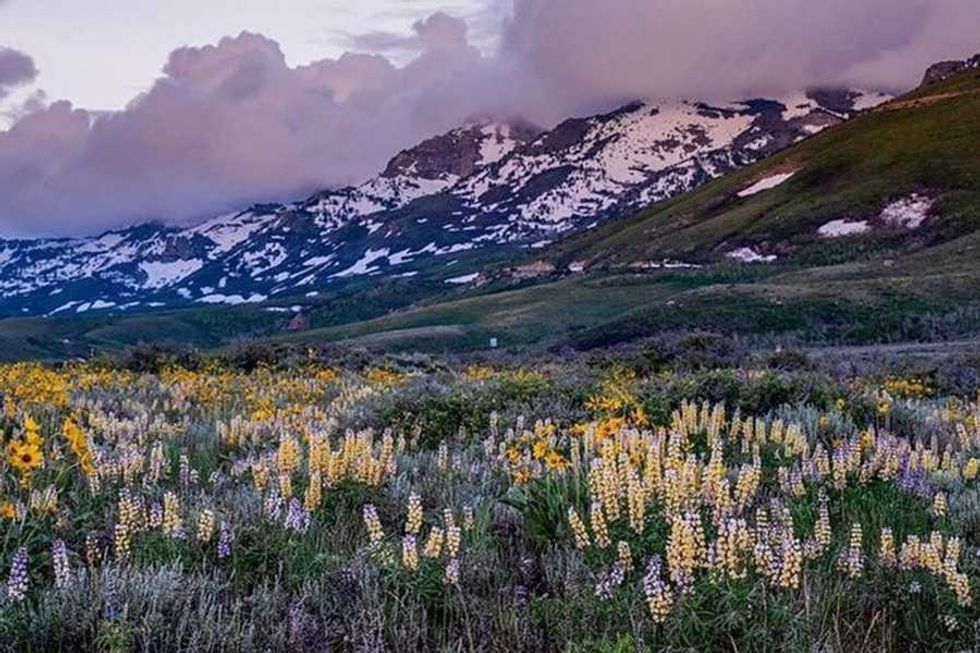 Ruby Mountains Wilderness(Courtesy of @travelnevada/@nevada_outside)
Stop 9: Bonneville Salt Flats
Distance: 138 miles, 2 hours 10 mins
Technically, the Bonneville Salt Flats are in Utah but they’re so close to the Nevada border on I-80 that skipping this extreme landscape—a hardpacked salt flat that shimmers like an ocean in the desert heat—would be a mistake. It’s so flat and so huge, you can virtually see the Earth’s curvature. Bonneville also has the fastest race track on the planet, where vehicles and motorcycles regularly set records for speed. If you want to catch some of the super-fast action, visit during Speed Week, which typically begins in early August. // I-80 (Greenhaven, Utah), utah.com