
A Gluten-Free Ride: How SF Chefs Are Embracing The New Starch-Intolerant Diner
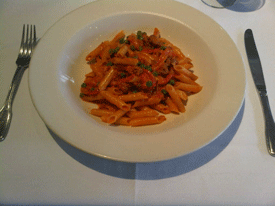
Gluten-free at Bacco in Noe Valley. Photo: GF in SF
Digest it for a second: "Gluten-free." Not the most appetizing of terms now, is it? But now diners with celiac disease and/or the related gluten-free diet restrictions are multiplying faster than active yeast. And it's in every restaurant owner's best interest -- be it Michael Mina or Ike Shehadeh -- to consider catering to the gluten-free lifestyle. Quick tutorial: gluten is the protein found in pasta, bread, pizza dough and pretty much anything made with wheat flour. After interviewing a handful of chefs around town, the term doesn't seem to faze most of them anymore.
Take Dennis Leary of the Tender Nob's Canteen: "Yes I suppose I accommodate gluten free - it's not terribly difficult. I don't have any agenda or plan. Just no wheat and it's relatives, sub with polenta or something. Incidentally, more than a few "gluten free" types eat my brioche with reckless abandon. Sigh." You know the dieting type, claiming gluten-intolerance so they can forgo pizza without social embarrassment. But for an ever-growing camp of people, eating gluten can legitimately induce nausea, cramping and some other things we'd rather not discuss in a food blog.
Enter Hoss Zare of Zare at Fly Trap: "Gluten-free is no problem," he says. Every staff member in his restaurant knows exactly how to handle the restrictions and, lucky for Zare, his Persian Californian menu is already built to be gluten-free friendly. He doesn't flour meats before cooking, nor does he thicken sauces or soups with any sort of roux (flour and butter), so there's no hidden starch in most things. "It's the customers that come in and ask for no onions or no garlic, that really kill me," he adds. "Those ingredients are in almost everything on my menu." Subbing a pile of fresh asparagus for the fregola in Zare's salmon entree is indeed a no brainer. A testament to the larger number of celiac sufferers walking through the door, he has recently gone out of his way to add a special gluten-free Persian custard dish called fereni to the dessert menu. "It's been gluten free long before celiac was ever documented," says Zare. "I top it with fresh carrot jam. It's delicious." Going with the gluten-free flow has come back to Zare ten-fold. "People talk. And good word-of-moth reputation has led to lots of happy customers coming back again and again."
Even undeniably bread-reliant places like American Grilled Cheese Kitchen are bending over backwards to accommodate the gluten-free set. Owners Nate Pollack and Heidi Gibson have formulated a gluten-free bread recipe in house for diners to substitute in any sandwich on the menu.
All chefs don't come around to the idea quite so quickly, as one would imagine, Vincenzo Cucco of Italian restaurant Bacco in Noe Valley -- a chef who's "like Primo from Big Night" according to his colleague and general manager Luca Zanet -- was a very hard-sell. Zanet works as a personal trainer during the daytime and went gluten-free years ago because it gave him more energy. "People think I'm a bad Italian," says Zanet. Around summer of last year he started to realize he wasn't the only one who liked to eat this way and he went about trying to change things at Bacco. After laborious taste-testing of countless local and international brands, he deemed the gluten-free pastas from Rustichella most worthy of a place on Bacco's menu. Surprisingly, the brand is based in Abruzzo. "Gluten-free is becoming more of a thing in Italy too," adds Zanet. Shocking. He had to slip the pasta into chef Cucco's bowl when he wasn't looking to get him to commit to the new noodles. Chef liked what he tasted; gave it the nod for the menu; now fast forward a few months and gluten-free tourists are calling Bacco from Chicago to make reservations at his restaurant. Their sous chef has since formulated a gluten-free homemade bread recipe to round things out. And Cucco is working on a recipe for handmade gluten-free pasta noodles he plans to release later this month.
Take it as a sign of the times that kitchen innovation has made everything from grilled cheese to pasta alfredo amenable to the gluten-free population. Maybe it's time to go on a "diet."

under Eat + Drink, American Grilled Cheese Kitchen, Bacco, canteen, dennis leary, Hoss Zare, Luca Zanet, Vincenzo Cucco
More Eat + Drink Postings
Add Comment
'When Celiacs Attack.' I have a gluten intolerance and I wish some of you commentators would stop making us all seem as fanatical and preachy as vegans. Sheesh.
Wow. As someone who has suffered from Celiac for 15 years, I appreciate what you are trying to draw attention to, but I concur with everyone else who has commented. Please re-write this article. Perhaps you could interview some chef's who are more knowledgeable and compassionate about the topic, not those that think Celiac is a fad diet. You have the potential to do something great with this article and you have fallen short. If I were your teacher I would give you a D+.
The word is spelled "faze" not "phase". Please check your spelling.
'faze' not 'phase'
Glad people are speaking out about the confusion between starch and gluten. I, too, have Ankylosing Spondylitis and can't eat any starch: no grains at all, no beans, no cooked root vegetables, no cornstarch, no tapioca, etc. etc. No gluten is easy in comparison and the confusion is not helpful to those of us with serious and medical dietary limitations.
As a journalist with Celiac, I have to say that this article is poorly researched and poorly written. If this reporter had spent more than 5 minutes likely googling "gluten allergy," he would have had the sense to avoid misrepresentations such as interchanging the words starch, gluten and protein. More importantly, WHY OH WHY would you insult the target reader of your story in your LEAD SENTENCE? "Gluten-free" has absolutely nothing to do with being appetizing or not...cheese is naturally GF, as is heavy cream, as are artichokes, most chocolate, charcuterie and wine. Labeling this term as unappetizing is fueling an ignorant misrepresentation. So now ALL of those that should be most pleased by this article are annoyed after the first sentence. Way to go. This article had so much potential to be great and you completely failed.
Gluten-free won't help people like me with Ankylosing Spondylitis (AS)condition in which you really cannot have starches. I'm glad people are challenging this article, thanks!
I agree with all the issues commented on before, particularly about cross-contamination. However, I was trying to get something useful out of the article. I followed the link to the Rustichella pasta website, because this was a brand I had not heard of. Right on the Rustichella home page it states their pasta is made from durum wheat. I dug deeper trying to see if they also made a gluten free pasta, but found none listed. It upsets me that restaurants would serve this to it's customers rbyt it also upsets me that the author of the article would include the link without even checking out the facts.
I am a personal chef who suffered from gluten-related health problems for many years, and I now cook for others who must eliminate all gluten from their diets. Correct, gluten is not a starch. It is a protein. And, while it's become a trendy diet to some, to those with celiac disease or gluten intolerance, ingesting even 1/6 teaspoon of gluten-containing food can cause serious health problems. Cross contamination is the biggest problem in commercial kitchens, as other readers have indicated. Restaurants that want to be a destination for celiac diners should seek counsel from the National Foundation for Celiac Awareness. They provide gluten-free certification for commercial kitchens.
My son has PKU, a rare genetic metabolic condition that is entirely treatable through dietary management: the problem: he eats about 5 grams of dietary protein a day, which means we're weighing his broccoli and raisins and counting his ritz crackers and apple jacks. A lot of gluten-free products are great for him because they are low in protein, but gluten-free is not an indicator of low-protein. As he reaches his fourth birthday, we're trying to figure out how to take him to restaurants and enjoy a (relatively) wide variety of foods, but that creates a lot of challenges. Hearing about chefs who are accommodating with gluten-free eaters gives me some hope we can find some places to take our son where we are not limited strictly to bringing his low-protein pasta and bread along.
Looks like the starch/protein info in the article has been clarified.
This is a stupid, ignorant article. Starch? What's gluten-free got to do with 'starch'--whatever that's supposed to mean... Clearly the writer means to ridicule--would they make fun of those crazy diabetics who need to avoid sugar? No, I think not (then again, *this* writer might!).
Bad job, SF Chronicle.
I too live with a gluten free spouse. It was hard to eat out at first but we found a great webpage called www.themissingmenu.com. It is place for people with food allergies to find restaurants that cater to their needs. It actually shows the restaurant's menu. We have found that too many restaurants say they cater to gluten free diners but when we arrive they offer a piece of plain chicken and rice. This page allows us to see what they offer before we make the reservation. It makes it easy to diner out again.
Allison is correct. This article has a lot of misinformation and does a huge disservice to the celiac community. It should be removed from SF Gate's website.
Gluten isn't a starch, it's a protein. And, while it's laudable that some of these establishments want to provide gluten-free ingredients, the real risk is in cross-contamination and handling. You can't grill a gluten-free grilled cheese sandwich on the same flat-top where you've done a regular sandwich. You can't just sub in polenta for pasta -- most polentas are processed in the same facilities as gluten-based products.
Maybe someone with celiac should've written this article, so the facts would be closer to accurate. This article should be removed from your website.
As others have mentioned, gluten isn't a starch; it's a protein.
And celiacs aren't on a 'diet' as your article implies, as though it's some choice we make at every meal and we can change our minds about eating gluten without consequences. Celiac disease is nasty, causes all kinds of serious physical problems to celiacs who are not on a gluten-free diet, and deadly if it remains untreated.
There is a growing trend among nonceliacs who have no medical reason to avoid gluten, i.e., they have not been diagnosed by a medical doctor as gluten intolerant, or allergic to gluten, and they are not at increased risk for lymphoma as a result of eating gluten. They have decided for whatever reason that gluten is bad. These are the brioche eaters that Dennis Leary describes in your article.
As a celiac, I am very grateful for restaurants that offer truly gluten-free options; restaurants that understand the importance of clean practices (no gluten ingredients on the kitchen counter, in the cookware, spices, etc). These restaurants make it possible for families who suffer from celiac disease to eat out and away from home.
My hope is that whey all the hype about gluten wears off and the nonceliacs go back to eating gluten with abandon, that restaurants still remain knowledgeable about celiac disease and willing to provide gluten-free options.
The bread is the most difficult and the key to being a good gluten free establishment. Pastas are widely available gluten free in Europe and Downunder, but in the US it seems to be a more difficult sell.
We've eaten gluten free since 1994, and reducing it in the family seems to also help with sugar and weight issues. Cutting out the fillers with gluten is also more gut friendly to your diet. Thanks chefs for trying to be at least more welcoming on our special diets!
Wheat is a relatively new food for humans of European descent (and especially Irish/Celtic). This is why sensitivity to the gluten protein is more pronounced in those populations. People of Middle Eastern descent are likely to be more tolerant because it originated there and the population has had more time to adapt. Gluten is readily available to the food industry and is used as an additive to many foodstuffs. Sensitivity isnt just limited to the coeliac disease, it includes inflammation of the GI, intestines. Many people, while not coeliac, still suffer a lifetime of ill effects ranging from allergies to depression. It is only being recognized today that cutting out gluten results in improved health for many. Btw, gluten-free products, especially desserts, are every bit as yummy if not more.
but... gluten isn't starch. This is the protein component of wheat, and can be used to make fake meat. Starch is what remains in white flour when the whole grain is processed and the protein is removed.
I appreciate the info, but wish you hadn't glossed over what happens when people who can't have gluten are exposed to it. It's far worse than a little discomfort, and luckily, we are blessed with many local eateries who treat this issue properly.
Starch isn't the problem; gluten is a protein.
Edinburgh, Scotland was the same...corner pubs had "please let your server know about any food intolerances" at the bottom of menus...maybe we Celts are more susceptible?
This is great news! We gluten-free folks are always on the lookout for restaurants that feature gluten-free meals. For instance, BJ's has a gluten-free pizza that is delicious! To clarify, people on a gluten-free diet are not only either just celiac or "dieting," we might also have an auto-immune disorder that is caused from "leaky gut," which is first caused by gluten and casein. After years of going gluten-free (eating the rare croissant or cookie here and there), I have found that I have mainly lost my taste for gluten foods--they taste too doughy and airy. Thanks for the article!
fyi
my sister-in-law has celiac disease and has nut allergies so (while I myself don't have issues with either) I've definitely become more attuned to these problems.
One thing I've noticed when traveling (Dublin, Ireland, is particularly good in this regard, for some reason) is that some places can help not just by catering explicitly to gluten-free needs (if they do), but even just by marking up menus appropriately (e.g. indicating dishes that contain nuts or which are gluten-free) it can make life much easier for people with food allergies trying to find foods that are safe to eat, without depending on wait staff to remember every last ingredient in a dish.
The Big Eat 2012: 100 Things to Try Before You Die
The Big Eat 2011: 100 Things to Try Before You Die
The Big Veg 2011: 50 Vegetarian (Or Vegan) Things to Eat Before You Die
Four Ways To Escape the Cold in Mexico
Jams We Love: Our Weekly Playlists
10 Best Dishes $10 in the Inner Sunset
Rise and Dine: A Guide to Brunch at SF's Best Restaurants
The Best Cheese in SF (Recommendations from Local Cheese Shops)
Refreshingly Unhip: The Best Vanilla Ice Cream in SF
The 20 Best Dishes Under $10 in the Tenderloin & Tendernob
Community Gardens Around the City
Horseback Riding Within 1.5 Hours of SF
Four Awesome Northern California Hot Springs
Refreshingly Unhip: SF's Old-School Pastrami Sandwiches
The 7 Best Carne Asada Burritos in San Francisco
The 10 Best Dishes Under $10 in the Outer Sunset
The 20 Best Dishes Under $10 in the Mission
The 10 Best Dishes Under $10 in Bernal Heights
The 10 Best Dishes Under $10 in the Lower Haight
The 10 Best Lunches in Union Square Under $10
Refreshingly Unhip: The Best Glazed Dougnuts in SF
Expert Advice on Parking in The City