
To artist Chiharu Shiota, yarn is a connective tissue. She uses it to string together opposing forces—past and present, the internal and external—in webs that appear delicate and fluid but are, in fact, steely and immobile.
Like arteries, the work in the new Asian Art Museum exhibition Chiharu Shiota: Two Home Countries pulses somewhere between the grotesque and beautiful, the unfathomable and the quotidian.
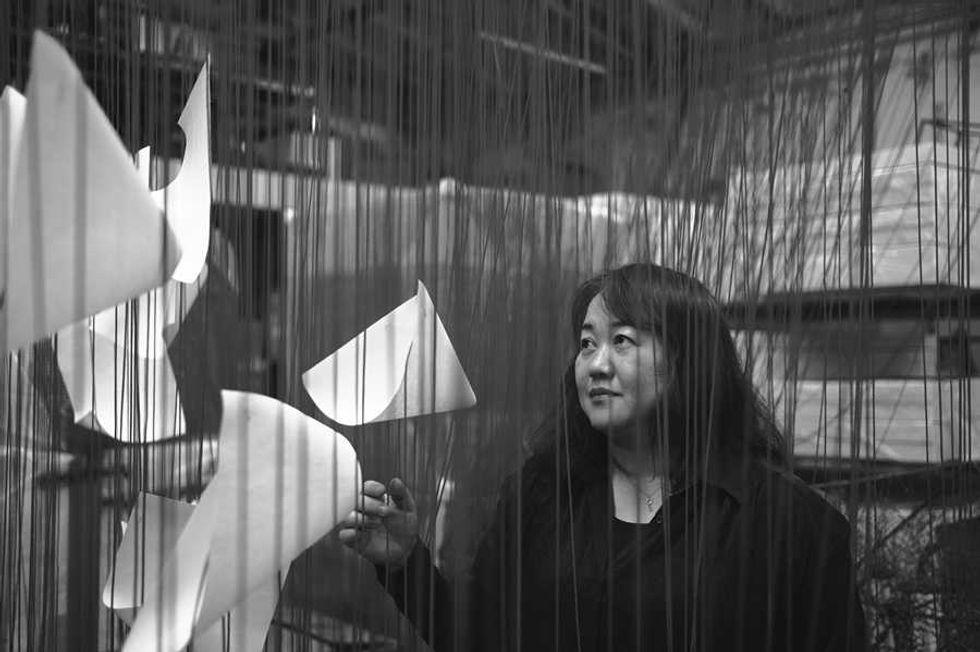 Japanese German artist Chiharu Shiota(Sunhi Mang, 2024)
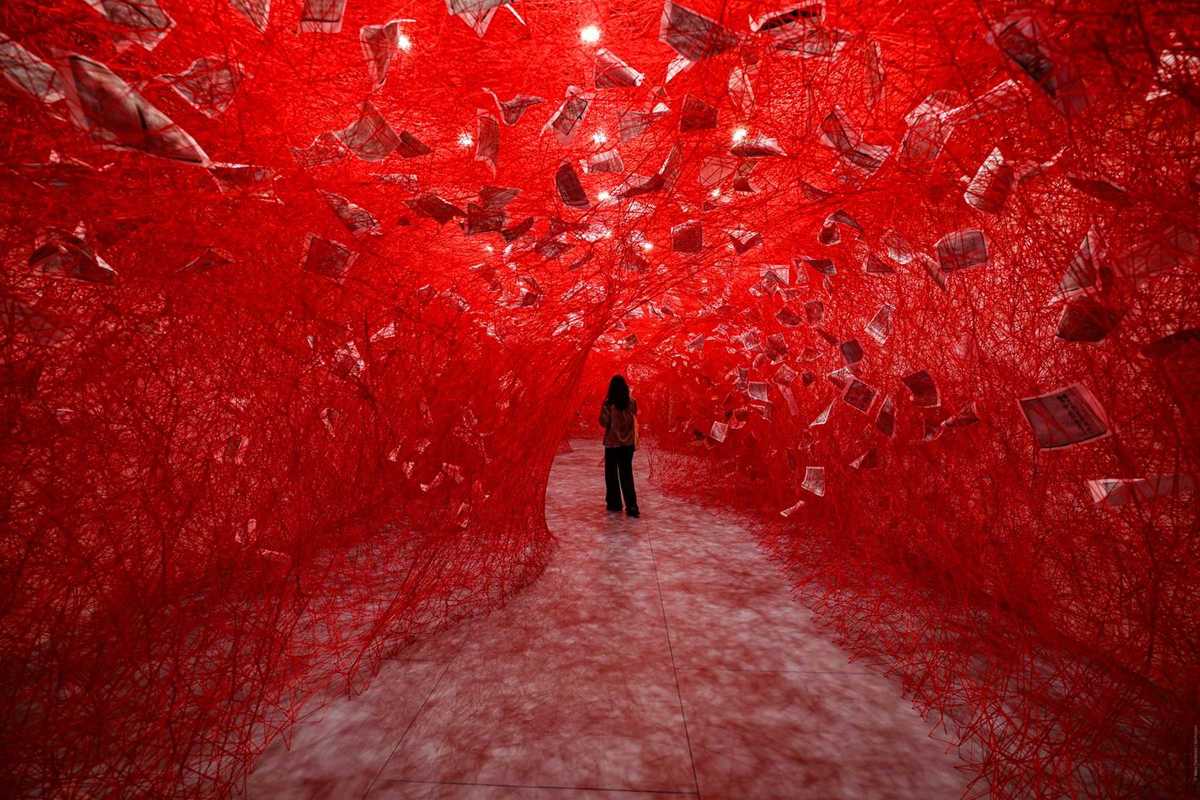
In Shiota’s work, “there’s a recurring theme of the way in which we perceive memory and traumatic experience, and how each of us grows from that experience,” explains chief curator Robert Mintz. It’s a theme that Diary, the womb-like immersive installation that opens the show, thrusts visitors deeply inside.
Shiota used 20 miles of red yarn to weave together Diary’s tunnels. In its latticework, she suspended historical ephemera like snowflakes—pages from the diaries of fallen Japanese soldiers in World War II combined with personal objects from the same era found at flea markets in Berlin. Collected together, they become a profoundly intimate archive of human experience that reveals what happens when memories are untethered from those who made them.
Chiharu Shiota describes her signature style as three-dimensional drawing, a medium she invented after becoming disillusioned with the restrictions of painting. Over her nearly thirty-year career, it's allowed the artist to confront the contradictions and tragedies of life while simultaneously drawing out their universality.
“My work is about birth and life and death,” the artist has said, a deeply personal approach that Mintz says is somewhat unusual among artists from the Japanese diaspora.
Shiota was born in Osaka in 1972 but has spent most of her adult life in Berlin. It was there that she gave birth to her daughter, there that she lost an unborn child, there that she survived two bouts of ovarian cancer. In the exhibition, she captures those experiences in thread and wire and rope and leather—always in red, a color of significance in many East Asian cultures: Beyond My Body encapsulates the feeling of being physically stuck by illness with an active mind that is still able to disconnect and reach outside; in the Cells series, she imagines the alien entities of the cancerous bodies inside of her.
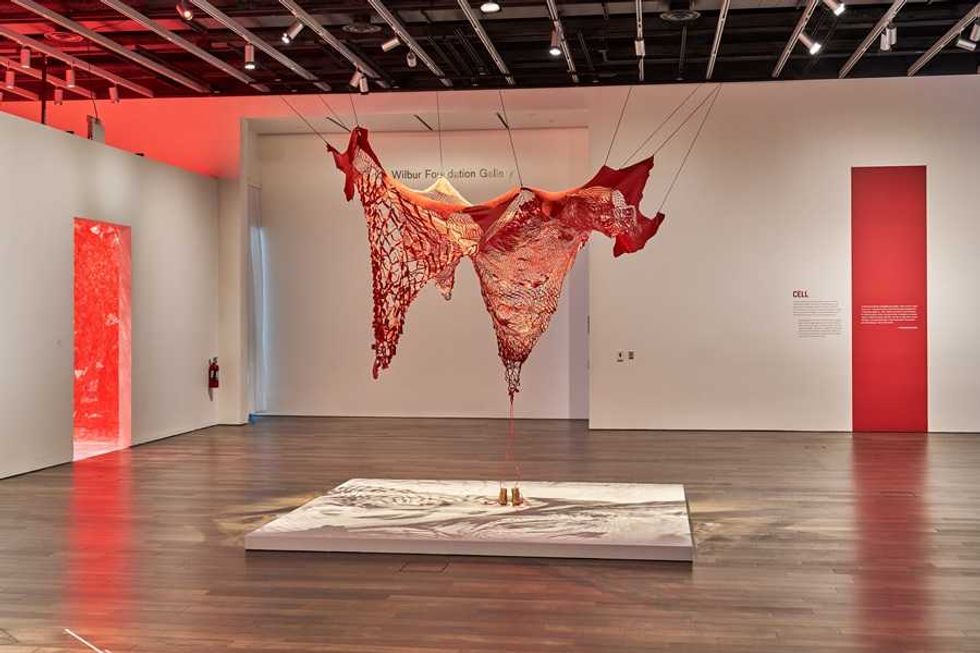 Installation view of 'Chiharu Shiota: Two Home Countries' at Asian Art Museum of San Francisco, 2026. (©️ Asian Art Museum of San Francisco, photograph by Kevin Candland)
Several examples of Shiota’s work as a performance artist explore similar themes, revealing publicly what’s more often kept hidden on the inside. In Wall, the artist lies on the floor wrapped in vein-like plastic tubing that fills and empties of blood, a substance that contains everything from heritage and nationality to identity and personality, says Mintz.
In the black-and-white Bathroom, Shiota sits in a tub as mud dribbles down her face and neck, communicating the sense that we can never be completely cleansed of what came before. “Your skin always remembers the dirt,” Mintz explains.
At the exhibition’s center is its namesake Two Home Countries, two houses without walls in which wire fistulas are coiled like the organs of the body, one representing Shiota’s native country of Japan, the other her adopted country of Germany. The two houses are separated not just by geographical distance; they illustrate the alienation of missing one home while visiting the other, of never fully belonging or feeling whole.
“She revels in the disruption,” says Mintz. “Joy and sorrow are always embedded in her work.”
That eternal juxtaposition is not cathartic; it’s not meant to be. Shiota offers no answers to soothe or explain the highs and lows of the human condition. Instead, her work embodies the uncertainty of life and the pain of remembering.
As she herself puts it: “fear is necessary to make art.”
// ‘Chiharu Shiota: Two Home Countries' is on display at the Asian Art Museum through July 20th; 200 Larkin St. (Civic Center), asianart.org
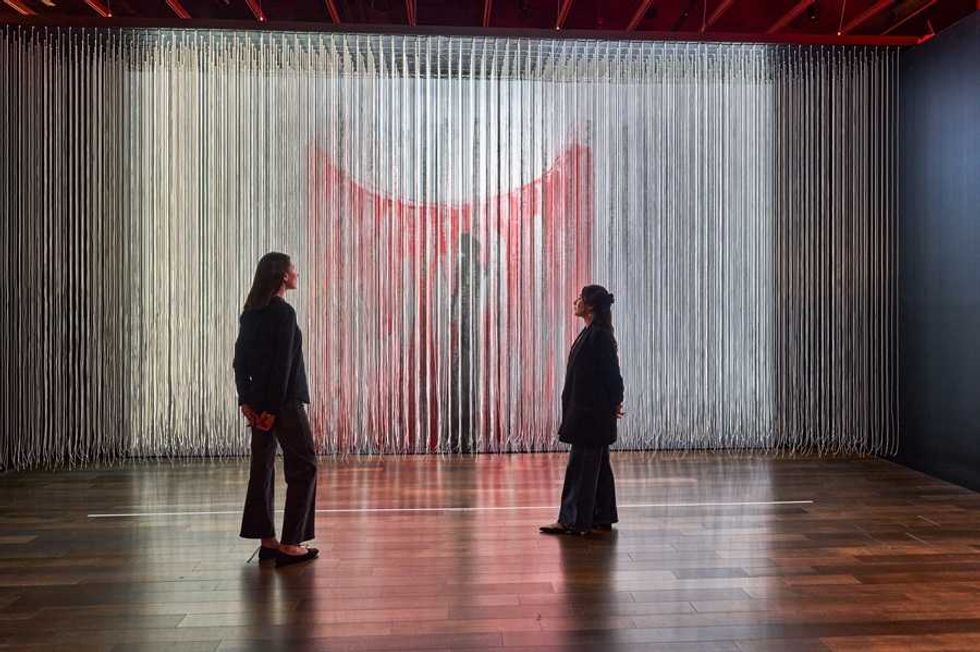 Installation view of 'Chiharu Shiota: Two Home Countries' at Asian Art Museum of San Francisco, 2026. (©️ Asian Art Museum of San Francisco, photograph by Kevin Candland)