
Renée Dreyfus, the fabulous curator in charge of ancient art at the Fine Arts Museums of San Francisco, has wanted to do an exhibition about the people who lived in present-day Tuscany from around 900 to 100 BCE—the Etruscans—since the ‘90s.
But really, her fascination started much earlier. Growing up in New York, Dreyfus remembers going to the Metropolitan Museum as a child and looking up at an eight-foot-tall statue of an Etruscan warrior.
“How could you not be impressed?” she says. “Years later, they found out it was a fake, but I was already hooked. I remember copying wall paintings from the Etruscan tombs and giving them to my parents to put on the refrigerator. I've always been intrigued by them, but the more I learned, the more I realized how important they are and they should not be overlooked.”
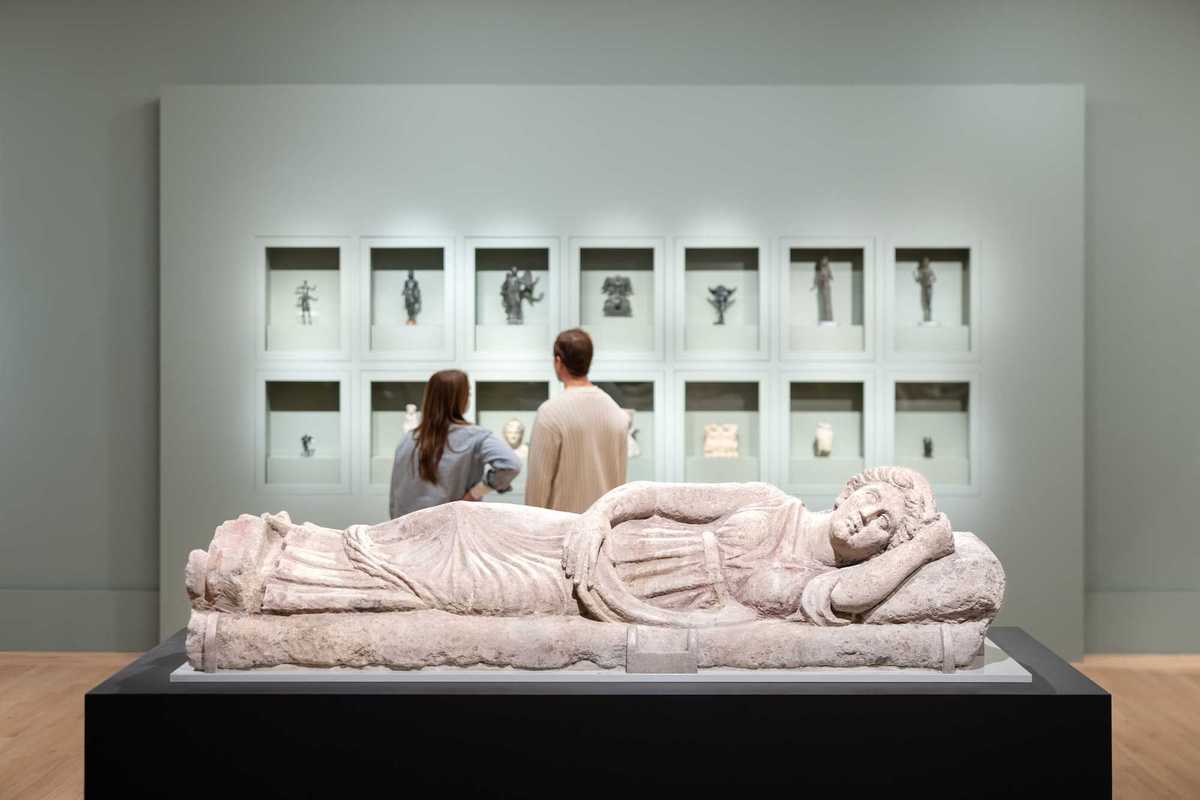
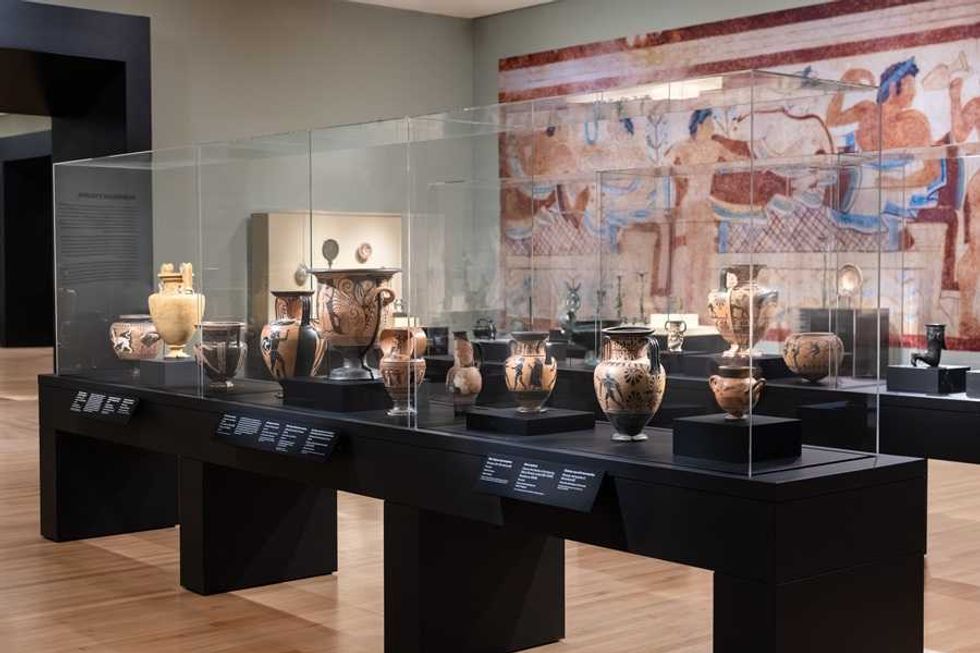 One of the galleries at 'The Etruscans: From the Heart of Ancient Italy' at the Legion of Honor(Gary Sexton)
Now, after doing the hard work of borrowing about 150 pieces from 28 institutions including the Vatican, the Hearst Museum of Anthropology at UC Berkeley, the British Museum, and the Metropolitan Museum, Dreyfus has created the most comprehensive exhibition on the culture yet in the United States. The Etruscans: From the Heart of Ancient Italy is about the huge advances in engineering and architecture made by the still somewhat mysterious people, along with their artistic achievements.
There really couldn’t be a better person than Dreyfus to organize this show. When she started at the museum in 1977, there was no antiquities department; she created it. Since then, she has curated more than 20 exhibitions, starting with Theophilos Hope D'Estrella: The Magic Lantern Man, about a deaf photographer, in 1978.
The next year she curated the de Young's blockbuster show, Treasures of Tutankhamun, which 1.3 million Egypt-crazed visitors attended in just four months. The exhibition inspired “wild and crazy guy” Steve Martin’s hit song “King Tut” (“Now, if I'd known / They'd line up just to see him / I'd taken all my money / And bought me a museum”), which he performed on Saturday Night Live. Thirty years later, in 2009, she organized Tutankhamun and the Golden Age of the Pharaohs at the same museum.
The current exhibition includes the tombs of elite Etruscans furnished like houses, along with explorations of their jewelry, pottery, deities, banquets, and the huge influence they had on the Roman Empire. The Etruscans built roads, developed underground drainage systems, dominated trade, pioneered winemaking, and came up with the numbering system known as “Roman numerals.”
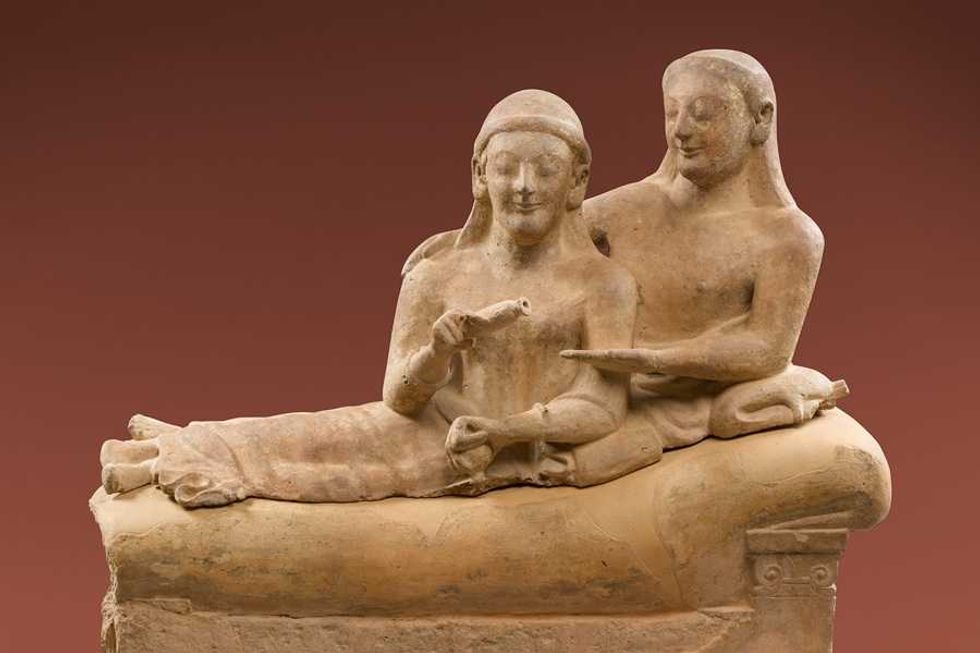 Cinerary urn of the spouses, Etruscan, Caere (modern Cerveteri) (detail), 520–500 BC. Terracotta, 22 x 22 7/8 x 9 7/8 in. (56 x 58 x 25 cm). Musée du Louvre, Paris, Purchase 1861, collection of the Marquis Giovanni Pietro Campana, Cp 5193.1–2(Courtesy of Fine Arts Museums of San Francisco)
The exhibition also shows how women were valued in Etruscan society. We see from paintings that they were included in banquets and weren’t depicted as smaller than the men, as they were in other ancient cultures. Etruscan women were allowed to run businesses and to own property.
Dreyfus points out the Etruscans' elegant and skilled craft in terracotta, bronze, and gold, such as a small drinking bowl textured by granulation—a technique they mastered.
“It's from 700 to 650 BCE, but it looks brand new. I would buy it if I saw it in Tiffany's window,” says Dreyfus. “The granulations are superb because they are smaller than any other culture has been able to do. They estimate that there are 250,000 granules on this single bowl.”
Among the showstoppers is the Liver of Piacenza, a bronze model of a sheep’s liver, different segments of which are marked with the names of the gods. If there was a major question to be answered, a sheep would be sacrificed and the blotches that landed on the liver would direct people to know which god was speaking. The Etruscans were known for divining the future, Dreyfus says; one even warned Julius Caesar about the Ides of March. The director of the museum in Piacenza came personally to deliver the model, which has never left its hometown before.
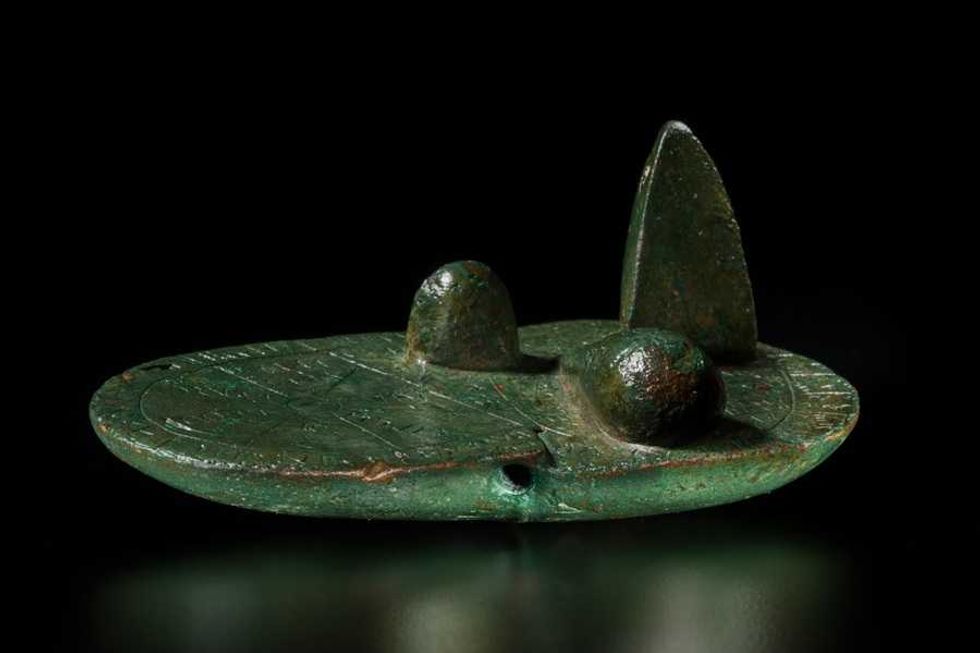 Etruscan, model of a sheep’s liver, found in Piacenza, 2nd century BC. Bronze, 4 15/16 x 3 x 2 3/8 in. (12.6 x 7.6 x 6 cm). (Courtesy of the Musei Civici di Palazzo Farnese, Piacenza)
Another piece that set museum officials’ hearts aflutter is the longest-surviving piece of Etruscan writing: a linen book with a calendar from the third century BCE noted with rituals and sacrifices. The linen would have deteriorated in the Italian climate, but the book survived because it was brought to Egypt—where it is drier—torn into strips, and used to wrap a mummy.
The decades-long wait to do this show was worth it, says Dreyfus. Indeed, the Etruscans are having something of a moment, with recent discoveries of bronze statues from a healing sanctuary in southern Tuscany included in the exhibition that offer insight into religious practices.
“The show is so much better now than it would have been 30 years ago,” she says. “There are more discoveries and [there’s] far more scholarship. When I was studying archaeology, maybe you had a couple months, if that, talking about the Etruscans. Now, it's entire semesters.”
Putting the show together took years, and Dreyfus’s experience and connections were a huge help in borrowing the items, many of which have never been shown outside Italy before. The support of the head of the national museums at Italy’s culture ministry—whom she worked with when he was the director of the Pompeii Museum on a show on Pompeii in 2021—helped immensely.
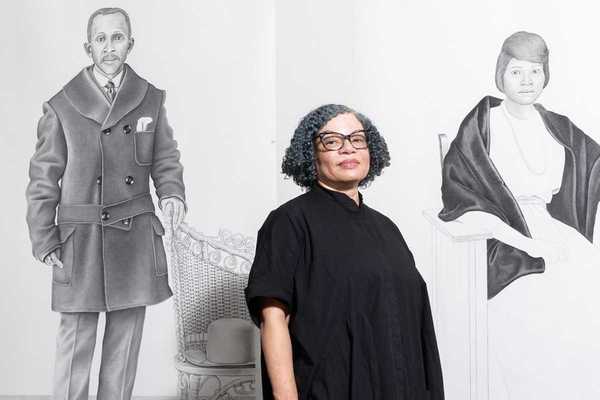
 Renée Dreyfus, curator of 'The Etruscans: From the Heart of Ancient Italy' at the Legion of Honor (Gary Sexton)
“The objects that are here are of the finest there are, and so many have never been in America before,” Dreyfus says. Getting their hands on some of them was nail-biting; the okay for the liver came less than two weeks before the exhibition opened.
“It was so last minute, and I was just thrilled,” she remembers. “Our couriers who came with the objects to oversee the installation walked through, and they couldn't believe what's here. They kept saying, ‘How did you get that? How did you get that? It's amazing.’”
// ‘The Etruscans: From the Heart of Ancient Italy’ is on view at the Legion of Honor through September 20th, 2026; 100 34th Ave. (Outer Richmond), famsf.org
- YouTube (Courtesy of www.youtube.com / Fine Arts Museums of San Francisco)